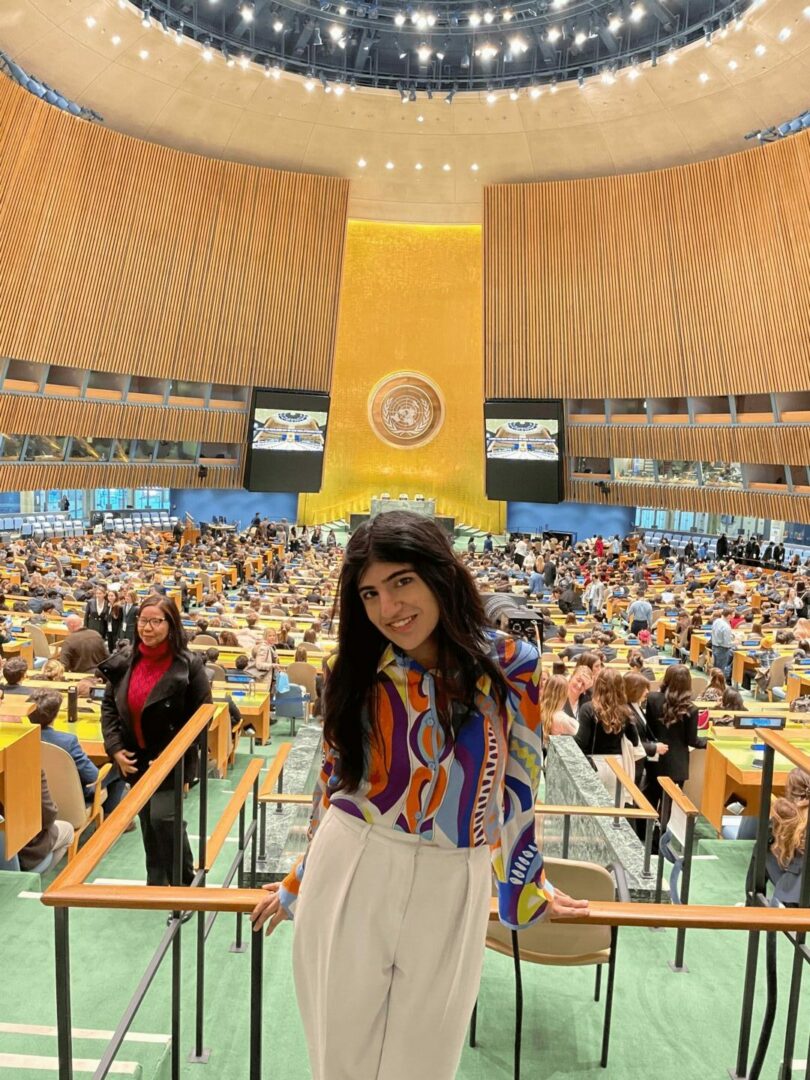
We recently connected with Aryana Wadhwani and have shared our conversation below.
Aryana , appreciate you making time for us and sharing your wisdom with the community. So many of us go through similar pain points throughout our journeys and so hearing about how others overcame obstacles can be helpful. One of those struggles is keeping creativity alive despite all the stresses, challenges and problems we might be dealing with. How do you keep your creativity alive?
My travels! My passion for interdisciplinary studies is all rooted in a trip to Mumbai, India, which I’ll get into later!
Today, as a member of the United Nations Framework Convention for Climate Change’s Youth Climate Movement (UNFCCC’s YOUNGO), I am constantly engaged in meetings pertaining to all sorts of topics from Child’s Rights, health to food and agriculture, hearing colleagues’ memoirs, anecdotes, and personal experiences impacting the way I think about policy and social justice. Hearing these many stories reminds me that in policymaking, especially legislation, one size never fits all.
Let’s take a small detour – maybe you can share a bit about yourself before we dive back into some of the other questions we had for you?
My passion for interdisciplinary studies began in elementary school, with the influence of my father and my 5th-grade teacher, Mrs. Natalie. What started as a simple recycling campaign around Atlanta Montessori International School transformed into a complex yet fascinating interdisciplinary web underpinning the route to global sustainable development.
I always expressed my passion for STEM-related fields at our oakwood dining table to my father. This engineer had trained me in Newtonian physics and the basics of wastewater as well as environmental engineering, an area his co-engineers had always struggled with, whether it was trying to figure out whether calcium carbonate, sodium chloride, or coagulants should be added to a system to maintain environmental equilibrium. My mother, an anesthesiologist, spent long hours, particularly during one summer. It was a Saturday evening, reciting her local anesthetics textbook, jumping from topics such as toxicology and the physiological implications of overexposure to adrenal glucocorticoids. It all made sense—the definition of a scientist had been long pinned to my head: one who considers a breadth of knowledge in theory, integrating an array of perspectives and peer reviews while profoundly examining the world’s most contemporary challenges. Noting that driving innovation and collaboration on the frontlines is critical, all of which increase the societal visibility of scholarly productivity, I began to sketch a picture of environmental toxicology into my head. Later on, this would become ‘environmental neurotoxicology’ when I started to dive deep into publications within the National Library of Medicine, Nature, and Wiley Online Library. I made a new mental note that pursuing multifaceted research requires critical thinking and understanding the need for complex, contextual, creative intellect.
Text then turned into real life: I noticed the upfront framework of neurodiversity, and probably, my first neuroscientific observation. Hundreds and hundreds of children were lined up on the grounds of the 10-30 story apartments in the East Andheri region of Mumbai, India, all easily looking at least five years old; however, unable to mutter a two-phrase sentence, and participating in no social interaction with others, not even their mothers. The reasoning behind India’s poor Sustainable Development Index Score of 29 had been answered right there and then. There was a total separation of those who lived in poverty versus those who were filthy rich–it was as if no effort had been made to mitigate the damage these children had experienced. There was no maternal health care plan and few early childhood education programs were offered by the Indian government; those that did exist had no concrete agenda. There was a market, a need, for this emerging field of environmental neurotoxicology—why hadn’t anything been done, or at least addressed? Even the various problems seen amongst these children and the non-existence of a maternal health care plan had to be approached from a multidisciplinary perspective, from overpopulation and educational systems to the country’s budgeting. To integrate interdisciplinary perspectives into society, policymakers must think from a multifaceted perspective—one size never fits all in the world of legislation.
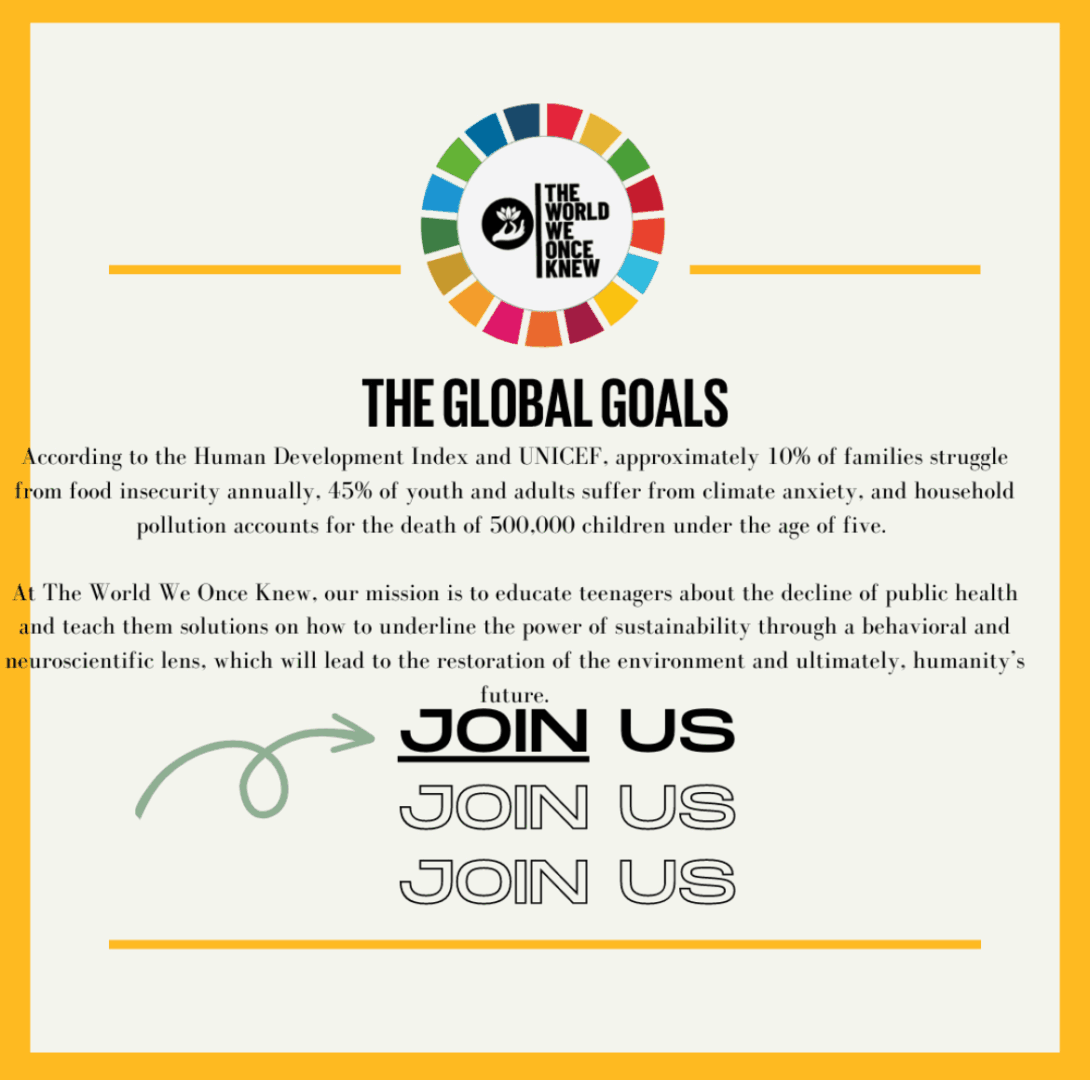
I further explored modules on how Responsible Appliance Disposal prototypes have played a role in sustainable development. Furthermore, I began communicating with professors, expanding on Bronfenbrenner’s Theory of Ecological Development in Children, examining how greenspace interacts with the child’s brain. I founded The World We Once Knew at the age of 15, the first non-profit organization where the emerging studies of neurotoxicology and modern global sustainable development empower the thinkers and advocates of future generations to reimagine the field of environmental health. Today, the World We Once Knew has reached over 20 countries globally and is a member of the Youth Climate Movement or International Youth Climate Movement (YOUNGO). I am also incredibly proud to announce that I will be a member of the Health and Agriculture and Food Working Groups at YOUNGO!
Within my endeavor to re-innovate public health, I firmly believe that intellect, creativity, and ingenuity pave the foundation for sustainable development and empathy to flourish. Then, the world we once knew becomes the world we all know.
There is so much advice out there about all the different skills and qualities folks need to develop in order to succeed in today’s highly competitive environment and often it can feel overwhelming. So, if we had to break it down to just the three that matter most, which three skills or qualities would you focus on?
1. Stay in the loop—notice your surroundings and what is happening around you; allow those stimuli to enter your thought processes, and take some moments of introspection to see how your passions can contribute to your neighborhood!
2. Do not fear if you do not conform to others’ “standards”- you are your own best advocate.
3. Be proactive- don’t wait for opportunities, create them. Reach out to local organizations with your innovative ideas, send those emails. Even if you receive few to no responses, keep pushing forward!
How can folks who want to work with you connect?
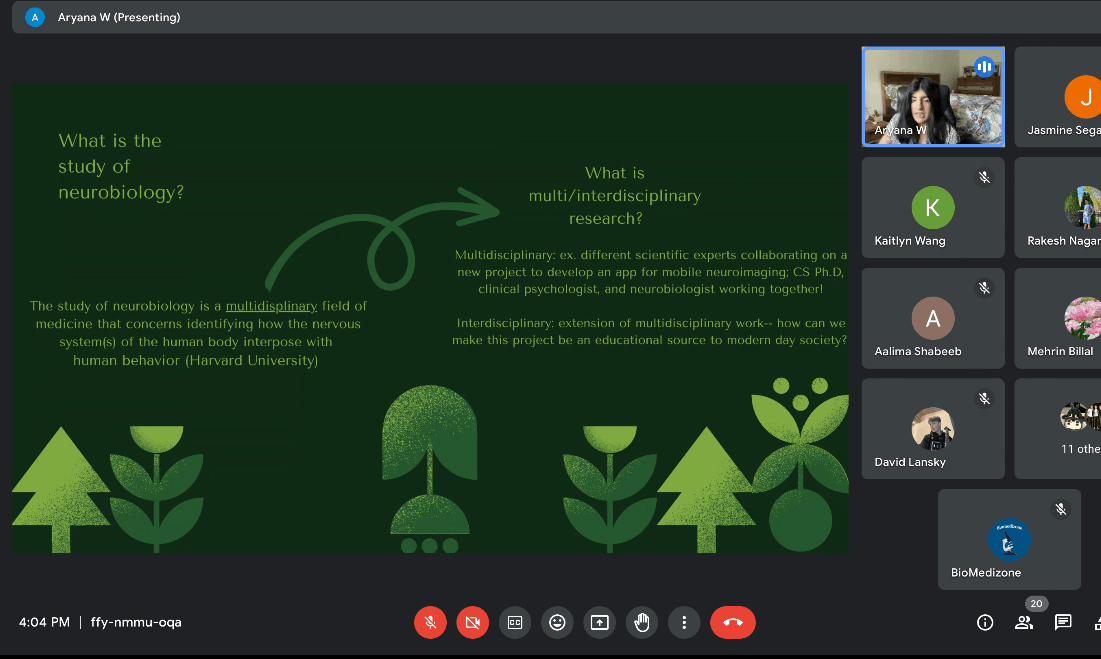
At The World We Once Knew, we are committed to educating teenagers through a multidisciplinary approach, exploring how the field of developmental neuroscience can change the route of global sustainable development. Therefore, we look forward to collaborating with individual partners and organizations that are spending considerable time delving into climate, environmental, and oceanic research to understand the social and economic pillars of reaching environmental equilibrium.
Specifically, we are also on the lookout for any teachers instructing any grade, whether primary or secondary, to discuss the greening of education in the classroom and beyond, in collaboration with UNESCO’s Secretariat of Greening Education Partnership!
Additionally, we are collaborating with Brilliant Labs in Nova Scotia, Canada, and we are recruiting fellow teens to participate in our Brilliant Blue Challenge this fall! Brilliant Blue is an exhilarating competition that invites teenagers across the states to explore the world of ocean innovation. I invite all teens to seize the opportunity to unleash their innovative ideas, protect our ocean, and propel the blue economy forward! Interested? Feel free to contact me through a DM on my organization’s Instagram or my personal LinkedIn!
Contact Info:
- Website: https://theworldweonceknew.org
- Instagram: https://www.instagram.com/theworldweonceknew_/
- Linkedin: https://www.linkedin.com/in/aryana-wadhwani-480957257/
so if you or someone you know deserves recognition please let us know here.