We caught up with the brilliant and insightful Jillene Cook a few weeks ago and have shared our conversation below.
Jillene, so happy to have you with us today. You are such a creative person, but have you ever head any sort of creativity block along the way? If so, can you talk to us about how you overcame or beat it?
Getting my butt in the chair. Yes. I know that sounds simple. But, more often than not, I find we disqualify ourselves before we even begin. As artists, we tend to run ourselves ragged with to-do lists, shows to watch, books to read, people to see, a house to clean, and we don’t give ourselves the opportunity to be bored, daydream, and ultimately be present to The Work.
I remember when I felt God invite me to participate in a childhood dream I considered to be as fantastical as becoming an astronaut—it seemed possible, but entirely unlikely! This dream was to be a writer. This invitation from God came at a time when my husband was due to live and film in Boston for six months; and, should I choose to quit my career of being a worship leader and youth pastor, I could go with him and leave behind the stresses of work… which would open up nothing but time and space to write!
I knew this was a wild, once-in-a-lifetime opportunity—to not have to worry about making money, but simply focus on a creative project all day everyday. Um… yes, okay, I’ll do that! Don’t get me wrong, making this choice was a challenging decision to come to, but I sensed God was on this move in a way that I couldn’t deny. There were open doors, hope, and joy at the thought of leaving everything behind to go chase a dream. So we did.
My brother would say to me, “Writers write. If you’re not writing, you’re not a writer.” Of course, this isn’t all-encompassing; but, it was the little pin-prick I needed to start. I had no idea what the end goal was: a blog, sermons, letters, an online guide? I didn’t know. Yet, I sat down at my desk for a few hours every day and wrote whatever came to mind.
When I wrote, my heart questioned what exactly I should be writing about. But, even in the unknowing, I would write because writers write. I pushed against the creative block by still participating in the act of writing. It wasn’t until I had an amazing phone call with someone I admire very much when I got a full download of exactly what project I needed to pursue. It was a book. During this phone call, I knew the structure of the book and the audience I was writing to. In a moment, everything became clear.
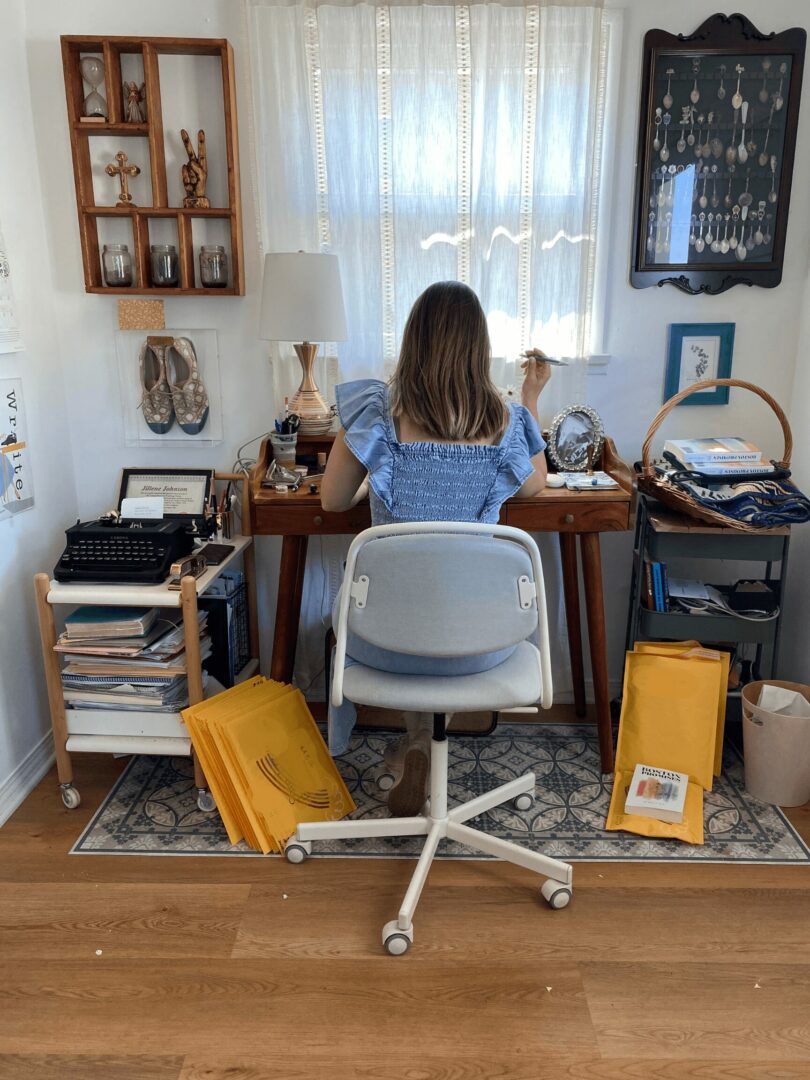
I signed up for a small online writing class and I began my writing project. I was so new to this idea, I remember googling how long chapters should be and how many words are normal in a typical manuscript. Those numbers became my goal and I would write until I hit those numbers. Though, again, the biggest creative block I would come across was not the actual writing and content, but getting my booty in the chair and at the desk in order to give myself over to the process. I know this might be a side-step around the question, but I wonder: How many of us feel a creative block, yet we aren’t putting ourselves in environments to be creative? For me, the environment I needed to succeed was a small office with just my computer and some inspiring sticky notes. I needed minimal distraction and consistency.
Again, sometimes we are blocked simply by the environment we are in, as well as the inaction of not choosing to put ourselves in the environment we actually need to thrive. I remember one of my professors in college (I earned my undergraduate degree in Dance in NYC) said that he always booked studio space three times per week. Even if he didn’t feel like dancing, he would show up to the space he rented out. Sometimes, he didn’t dance at all but instead journaled or even slept on the floor. Even when the space was booked, he would have the very normal artistic feeling we all have—the feeling that communicates I’m not in the mood. I don’t feel inspired. I’m so tired. I don’t think anything is going to come out of today. Though, having the studio space booked still turned out to be valuable because he’d show up, a glimmer of an idea would come, and he’d create something incredible (that often ended up being used for his shows or productions!). The rhythm and environment was important to sustain for when the inspiration stirred.
A space can change everything about how we feel, think, create, and act. Spaces inform us for better or for worse. Trying to sit down and write in a chaotic, noisy space will bring one thing out for one type of artist, while a silent, all-white, clean desk space will bring out something for another artist. Part of being an artist is knowing what environment is going to get your creative juices flowing; then, you fight for that space and create a rhythm to be in it. We shouldn’t choose whether or not to create based on how we are feeling because feelings change. The discipline is often what frees a creative block.
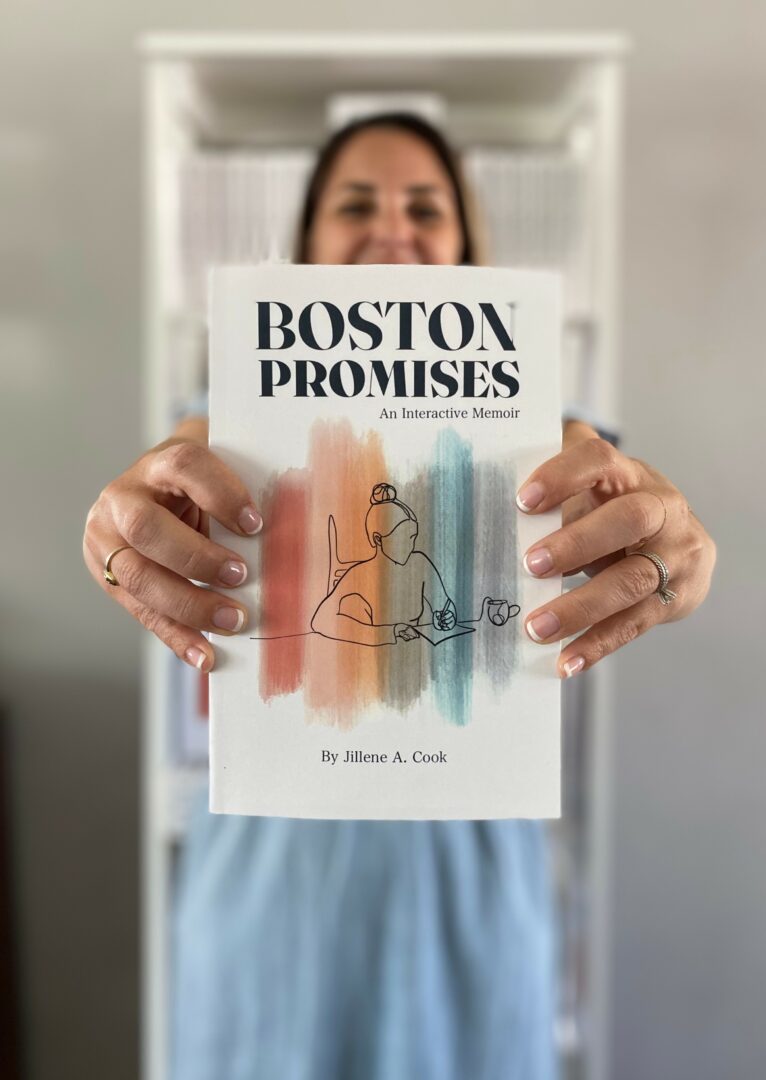
This journey of fighting to write a book and commit to this dream is a lot of what my memoir, Boston Promises, ended up being about. I’ve had others come to me after reading this book and share, “I was inspired to write a book myself. This is what I needed to finish the book I started!” Or, I’ve also heard, “I’m finally going to open the business I’ve been wanting to start.” This isn’t because my memoir is a how-to book, but an honest portrayal of all that was going on in my life while I was trying to write a book and stay committed to finishing. In that way, it is pretty meta… reading a book about writing a book. But it is the evidence of how I would fight against my own creative block, which was essentially busying myself, or sleeping in, or cleaning instead of getting myself in my creative environment.
The last thing I’ll say, specifically regarding writing, is that you’re a writer, not an editor. Do the work of writing without judgment and criticism. When it comes to your words and ideas, you can always change them or make them shorter or longer later. When it comes to the process of writing, just let it flow. When you’re done, find an editor you trust and let them do the carving away with you. That’s their gift. You do your gift of creating content. Otherwise, the judgment and criticism will stop you before you even get started.
If you would like to take a step toward breaking down this creative block, I would consider journaling through the following questions:
When was a time you felt most creative in your life and it was easy to flow in your craft? What was the environment like? Did you need people surrounding you? Or solo time? How much time did you have to participate in this creative endeavor?
What type of environment completely robs you of anything creative? Name some people, places, and activities that absolutely block your flow.
Think about the current environment where you are trying to be creative. What parts are helpful and what parts are unhelpful?
When you are in your exact helpful environment and still no ideas are coming to mind, what kind of thoughts are you having? What, if at all, are you accusing yourself of? What are your beliefs around messing up or doing a messy job as you create?
What is the scariest part about succeeding? Could that fear be your creative block? Where is the block actually serving you in some other way? What would it take to let go of that comfort (e.g.,tools, a mindset change, coaching)?
I pray, for whoever reads this, that these ideas give you a little shift towards flowing in your God-given creativity. You can do it. I believe in you.
Thanks for sharing that. So, before we get any further into our conversation, can you tell our readers a bit about yourself and what you’re working on?
I have self-published two books in the last two years: Boston Promises: An Interactive Memoir and The Guide, a devotional based on the prompts and questions posed in Boston Promises. Both are available for purchase on Amazon. I also have a YouTube channel that offers a streaming devotional which goes through the first half of The Guide for those who want a video devotional.
I am a Spiritual Director in Southern California. I meet with people one-on-one via Zoom for Spiritual Direction sessions. I love getting to pray with others and help them discern the movement of what God is doing in and through them in a given season. I meet with people in every walk of life. This might be someone who needs direction in decision-making, someone experiencing a deep disconnect from God, someone navigating loss, someone needing guidance in ministry, someone navigating the arts, or someone in a season of celebration who wants to stay connected with God along the way. I meet with those who are looking to deepen their relationship with God through the Holy Spirit and take a closer look at how God is transforming them to look like Jesus in their current circumstance, no matter what it may be. It is an honor to meet with each and every person and look into the beauty of what God has for them. There’s more information about what Spiritual Direction is on my website, JilleneACook.com
There is so much advice out there about all the different skills and qualities folks need to develop in order to succeed in today’s highly competitive environment and often it can feel overwhelming. So, if we had to break it down to just the three that matter most, which three skills or qualities would you focus on?
The three skills I think were most helpful in the writing process are discipline, tenacity, and prayer. Discipline goes back to creating a rhythm of showing up every day and guarding that time. No one is in charge of your time but you, but everyone else will want it. It’s the most valuable thing we have! Making time for our craft over scrolling on social media, watching tv, or whatever else we can get lost in is the main battle. Do whatever you have to do to protect this time. (I deleted Instagram for two years while I wrote my book!)
Tenacity because something will go wrong in the process. It always does; there’s always a setback. It’s not about doing a craft perfectly with no setbacks, but getting back up and redirecting when the setback comes. Honestly, we must’ve re-uploaded my Boston Promises manuscript at least 10 different times before we got all the kinks out. We experienced setback after setback, but kept going, trusting the full process and end result would be worth it.
Lastly, I say prayer because it is so important to connect with the Creator when being creative. It’s so important to remember your identity and value is based on who you are, not what you produce. Every day, I needed to check in with my soul and with God to make sure I was connected to who I was and whose I was (God’s child) so I wouldn’t get lost in the overwhelm of creativity. It’s so easy to put our value in our craft. Our craft is a gift for others and a blessing, not an identity. Time in solitude, and silence, and prayer gave me the strength to keep detaching and moving forward.

Thanks so much for sharing all these insights with us today. Before we go, is there a book that’s played in important role in your development?
The Spiritual Disciplines Handbook by Adele Ahlberg Calhoun has been an amazing resource for discovering different spiritual disciplines and practices that nurture the specific season you are in. I would highly recommend this book for those looking for a specific practice that can help them remain open to God and the movement of the Holy Spirit in their lives. In my own life, I have found that the more connected I am to God, the braver I am to embark on new creative journeys. When we are connected to love, it’s that much harder to let our fears get in the way. And fear is usually what destroys creativity!
Contact Info:
- Website: [email protected]
- Instagram: @jillene_a_cook
- Facebook: [email protected]
- Youtube: https://www.youtube.com/@jilleneacook
so if you or someone you know deserves recognition please let us know here.