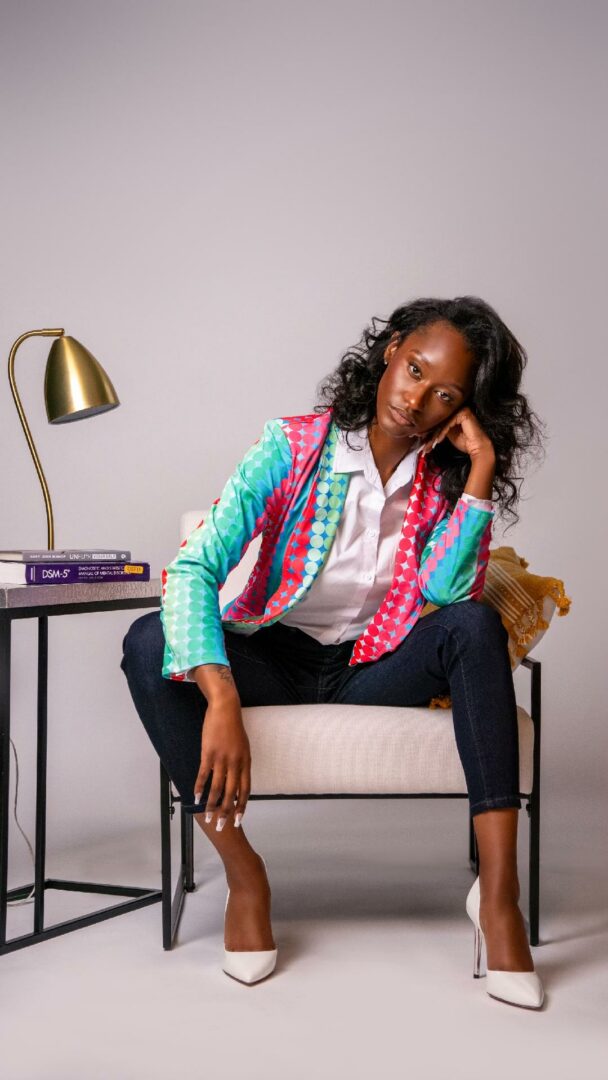
We’re looking forward to introducing you to Amanda “Mandii” Brown. Check out our conversation below.
Amanda “Mandii”, a huge thanks to you for investing the time to share your wisdom with those who are seeking it. We think it’s so important for us to share stories with our neighbors, friends and community because knowledge multiples when we share with each other. Let’s jump in: What is a normal day like for you right now?
A normal day for me starts early like, before I’m even fully awake. I get my two daughters up and ready, drop them off at their bus stop, and depending on how the morning’s going, I’ll sometimes make lunch for my partner before the day officially starts. Some mornings I’m lecturing as an adjunct professor in psychology or criminal justice, and other mornings I head straight to campus for my work as a mental health counselor at the university.
Once I’m in work mode, the day fills up fast. I meet with students for counseling sessions, handle crisis calls, and work with staff or faculty to make sure students have the support they need. I also partner with a few local organizations to connect our students with community resources. Most days I’m still at work until about 3:30 or 4:30, depending on what’s going on.
After that, it’s straight into mom mode again. I pick up the girls, and on certain days, I take my son, Zachariah, to his therapy appointments. Evenings are where everything blends together — cooking dinner, cleaning up, checking homework, and just trying to keep the house in motion. If I’m lucky, I can sneak in a quick nap or a long shower before sitting back down to finish up work, prep for class, or create content for “The Relatable Counselor” or “Well, What Had Happened Was.”
And when the house finally quiets down, that’s when I can breathe again. Most nights, I end up laying under my partner while he watches his shows or sports, that’s honestly the only way I can fall asleep. I can’t ever get fully comfortable until I’ve bothered him a little or snuggled up first. He’s my scoop of peace. It’s the one part of my day that slows everything down , where I don’t have to be “on” for anyone.
Most days are nonstop, but they’re full of purpose. Between being a mom, a partner, a therapist, a professor, and an advocate, I stay busy but I’ve learned to find small, quiet moments that remind me I’m still human, still loved, and still healing right alongside everyone I help.
Can you briefly introduce yourself and share what makes you or your brand unique?
My name is Amanda “Mandii” Brown, and I’m a licensed therapist, mental health counselor, and the founder of “Well, What Had Happened Was,” a storytelling-based mental health platform designed to create culturally relevant spaces for healing, connection, and learning. I’m also known as “The Relatable Counselor,” which really captures how I show up in my work — approachable, honest, and real. My goal is to make mental health conversations accessible and relatable, especially for Black, Brown, and Spanish communities who often face barriers to care or feel unseen in traditional mental health spaces.
I hold master’s degrees in Clinical Mental Health Counseling and Restorative Justice, and my journey is deeply rooted in both my personal experiences and professional training. As a domestic violence survivor, mother, therapist, and advocate, I’ve experienced firsthand the ways trauma, systemic barriers, and cultural stigma can impact emotional well-being. That’s why my work isn’t just about therapy in the traditional sense, it’s about storytelling, community, and emotional literacy. I strive to create spaces where people can feel safe to explore their experiences, reflect, and grow, without judgment or pressure.
Through my brand, I’m currently working on expanding workshops, online content, and community initiatives that blend mental health, advocacy, and social justice. I focus on helping people navigate complex life experiences — from co-parenting with trauma in the mix, to understanding emotional triggers, to supporting healing in marginalized communities. What makes my work unique is that it’s both clinical and lived-experience grounded: I meet people where they are, speak truthfully about challenges, and provide strategies that are practical, evidence-based, and culturally resonant.
At the core of everything I do is the belief that healing doesn’t have to be isolating or intimidating. With the right tools, guidance, and community, people can reclaim their peace, voice, and confidence — and that’s what drives me every day.
Great, so let’s dive into your journey a bit more. Who were you before the world told you who you had to be?
Before the world told me who I had to be, I was little Amanda — a happy but angry Afro-Latina child, full of life, curiosity, and a spirit that didn’t always fit neatly into the boxes people tried to put me in. I was vibrant, loud, and fearless in ways that sometimes made adults uncomfortable, and my emotions ran deep: joy and anger, laughter and frustration, all coexisting in a way that felt natural to me but confusing to others. From a young age, I embodied masculinity, shaped not only by my environment but by my upbringing. Living under my father’s strong influence, I absorbed his sense of authority, discipline, and resilience, while my mother’s insistence that I be hyper-independent forced me to navigate the world with strength and self-reliance far earlier than most children.
I was constantly called “a little lady,” a phrase meant to shape my behavior and demeanor, but it never fully captured who I was. I was bold, fierce, and unafraid to claim space — qualities that didn’t always align with society’s narrow definitions of femininity. I carried contradictions with me naturally: vulnerability and toughness, sensitivity and defiance, independence and a yearning for connection. I was learning to negotiate the expectations of others while still trying to hold onto the joy, curiosity, and raw authenticity that made me unique.
Even in that early version of myself, there was a quiet wisdom and resilience forming. I was already learning how to navigate complexity, protect my heart, and assert my identity in a world that wanted to define it for me. That little girl — happy, angry, and unapologetically alive — is still with me today. She is the foundation of who I am: a woman who balances strength and vulnerability, independence and connection, and a commitment to living life on her own terms, while holding space for others to do the same.
Was there ever a time you almost gave up?
Yes. There was a time I didn’t just almost give up — I actually did. On April 30, 2017, just weeks before I was supposed to walk across the stage for my undergraduate graduation, I reached a breaking point. Life felt unbearably heavy. I was carrying the weight of trauma, heartbreak, and unhealed pain that I had managed to hide behind academic success and resilience. Everyone saw the strong woman who kept pushing through, but they didn’t see the exhaustion, the silence, or the deep emptiness I felt inside.
So a lot of these questions go deep, but if you are open to it, we’ve got a few more questions that we’d love to get your take on. What important truth do very few people agree with you on?
An important truth that very few people agree with me on is that healing isn’t always pretty and it’s not supposed to be. We talk about healing like it’s this calm, linear process full of self-care routines, affirmations, and peace, but in reality, it’s often messy, lonely, and deeply uncomfortable. Sometimes healing means losing people you thought were permanent. Sometimes it means questioning your faith, your identity, or even the version of yourself you thought you wanted to be. It’s not soft work, it’s shadow work.
People often assume that because I’m a therapist, I live in a constant state of balance or peace. But real healing requires breaking patterns that once kept you safe, confronting truths that hurt, and grieving versions of yourself that no longer fit. It’s crying in silence after helping others all day. It’s setting boundaries and being misunderstood for it. It’s saying “no” and then sitting with the guilt until you learn to trust that “no” as protection instead of punishment.
Most people want the outcome of healing without the process of it. But I’ve learned through my own story and the stories I hold for others that the real beauty of healing lives in the chaos, not the calm.
Okay, so let’s keep going with one more question that means a lot to us: Could you give everything your best, even if no one ever praised you for it?
Yes. I give my best even when no one notices, because that’s just how I operate. I can’t control whether people see it, praise it, or even care, and I’ve learned that waiting for approval only slows me down. I do things right, I do things fully, because I owe it to myself, not to anyone else.
Contact Info:
- Website: https://www.therelatablecounselor.com
- Instagram: @the_relatable_counselor
so if you or someone you know deserves recognition please let us know here.