We recently connected with Kuhoo Mitra and have shared our conversation below.
Kuhoo, thank you so much for joining us today. Let’s jump right into something we’re really interested in hearing about from you – being the only one in the room. So many of us find ourselves as the only woman in the room, the only immigrant or the only artist in the room, etc. Can you talk to us about how you have learned to be effective and successful in situations where you are the only one in the room like you?
Before I moved to New York City in the fall of 2021 to pursue a BFA in Illustration, I had never truly known what it is like to stand out or be different. I grew up in Kolkata, a city in Eastern India – one that most Americans have never heard of. I spent the first 18 years of my life in the same city, surrounded by people who spoke the same languages as me, had the same accent as me, and grew up eating the same kind of food as me.
When I opened my acceptance letter for the first time, all I could think about was the doors that would open for me when I moved to New York, and the opportunities I would have that I could only dream of in the past. Back then, I did not even know what the term “culture shock” meant. During my freshman year in art school, there were no other South Asian students in any of my classes. Before class started, and during breaks, I would overhear my classmates talking to each other in their native language, and feel this pang of sadness when I realized that the only times I got to speak Bangla anymore was on the phone with my parents. On the last day of freshman year, one of my classmates made a very cute illustration of our cohort. The first thing I noticed was how my brown skin stood out like a sore thumb amidst a sea of White and East Asian students.
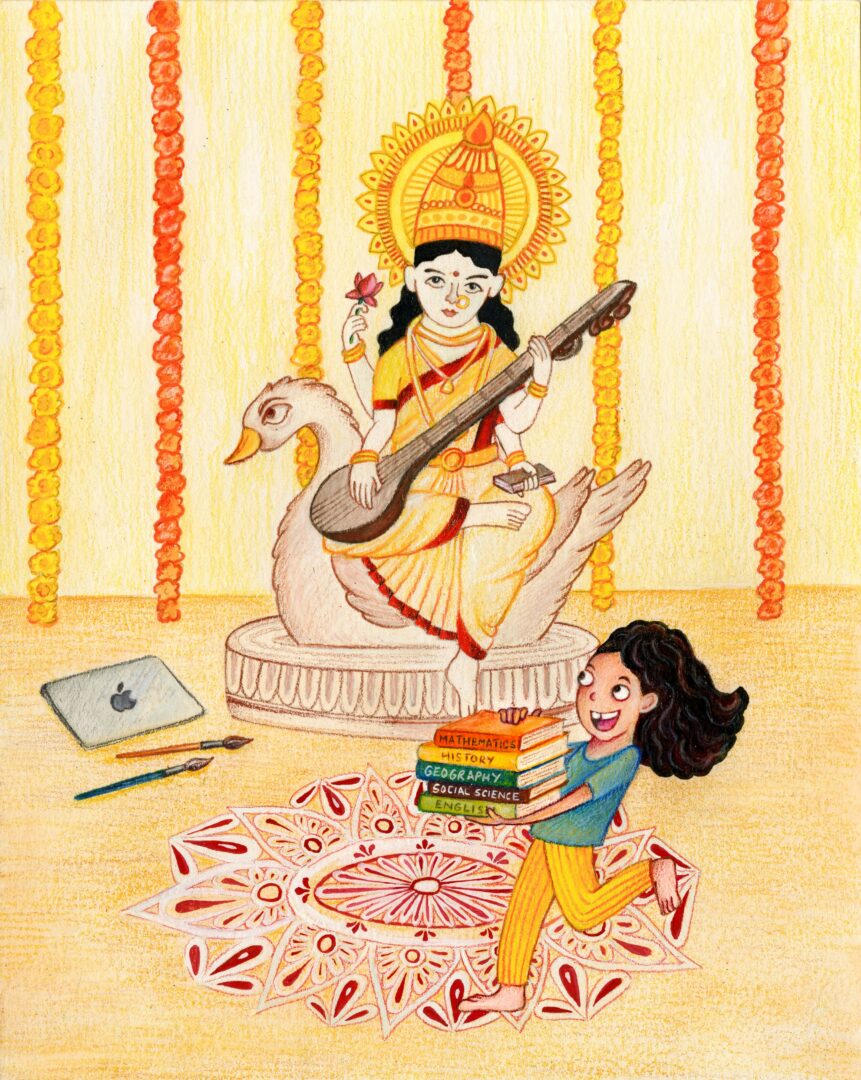
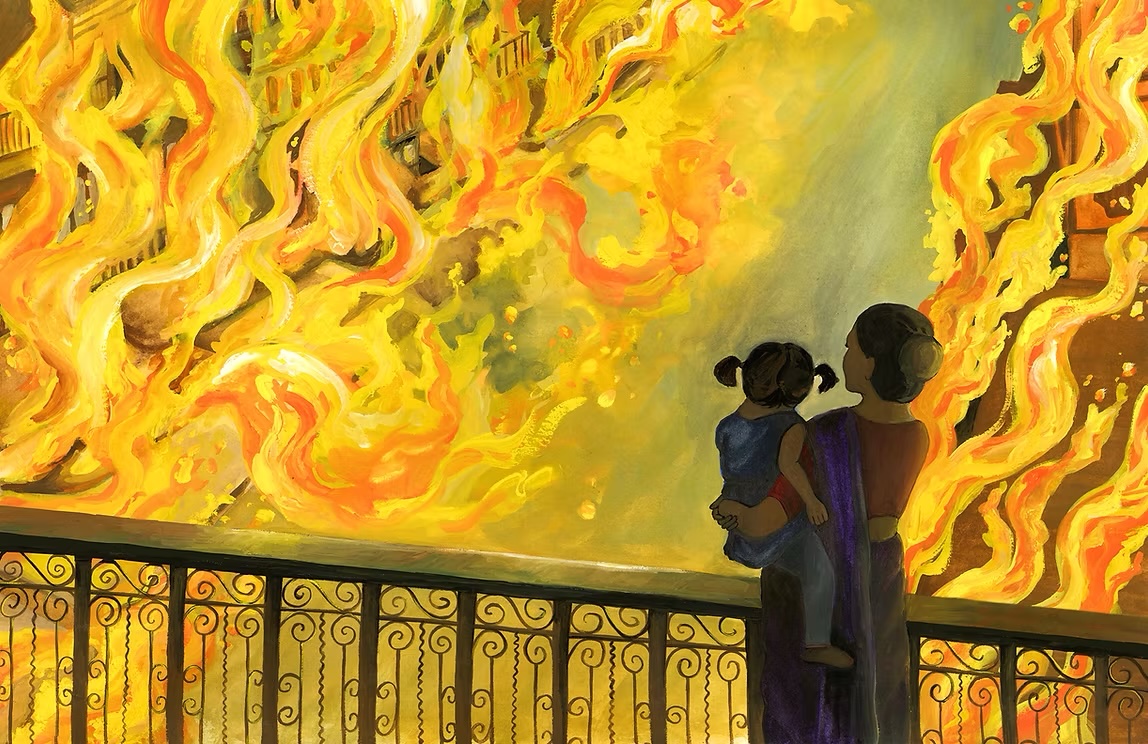
Initially, this made me feel homesick and alone. However, I soon realized that this meant I had stories to tell that no one else knew of. I was the only one in my class who knew about “Durga Puja”, “Saraswati Puja” and “Poila Boishakh” (festivals celebrated in Bengal), the only one who had fond memories associated with street food and desserts from my hometown, and the only one who had heard stories from my parents and grandparents about the Partition of Bengal that happened during the Independence of India in 1947. This became the basis of all of my work. I decided that if where I come from defines how I am viewed, then I will use my platform and my voice to tell authentic stories about my culture, break stereotypes and spread awareness. Sadly, almost all Indian representation in the West is about North India and South India. The Eastern and North-Eastern parts of the country are almost entirely ignored. I have always identified far more strongly as being Bengali than being Indian, so I took it upon myself to write and illustrate stories about Bengal. Doing so makes me feel as close to home as possible. Before I start a new project, I often spend days researching specific rituals, recipes and outfits. During the process, I always discover at least one fun fact, or a strange piece of history, or a weird origin of something that used to be a part of my daily life back home!
It has not always been easy. I have been told that my work does not look “Desi enough”. When I include Bangla typography in my illustrations, many people assume it is Hindi/Sanskrit. I have been asked, “Why make a book about Durga Puja? What not Diwali, since it is more popular?” and “Isn’t phuchka the same as pani puri?” These comments and questions sometimes frustrate me, as they make me feel like my identity and art needs to fit into a neat little box in order to be valid. However, these comments and questions are also what drive me to keep making more art that challenges these stereotypes, and educates people about the diversity in South Asian cultures.
Thanks, so before we move on maybe you can share a bit more about yourself?
My love for stories, books and art is as old as myself. My parents, both avid readers themselves, filled my bookshelves with picture books even before I had learnt to read independently. I would flip through the board books, and try to figure out the story from just the images. If I couldn’t quite decipher what was happening, I would let my own imagination take over. I remember having a lot of books with black and white illustrations in them. I must have been five or six, when I started coloring them with my crayons and colored pencils. According to my Mom, I was probably eight or nine when I proudly declared “I want to draw pictures in books” when asked what I want to be when I grow up. Flash forward more than a decade later, I am still chasing that dream.
I consider myself a storyteller more than anything else. Anything I create, I hope there is a story at the heart of it. In terms of mediums, I am quite flexible and experimental. While digital art has its own charm, I personally feel nothing compares to the tangibility of traditional art – touching the different materials, feeling the texture of the paper between my fingers, making a mistake and knowing that I can’t go back – there is something magical about the whole process! I love working with watercolors, gouache and colored pencils. I also do printmaking – linocuts, silkscreen and riso printing!
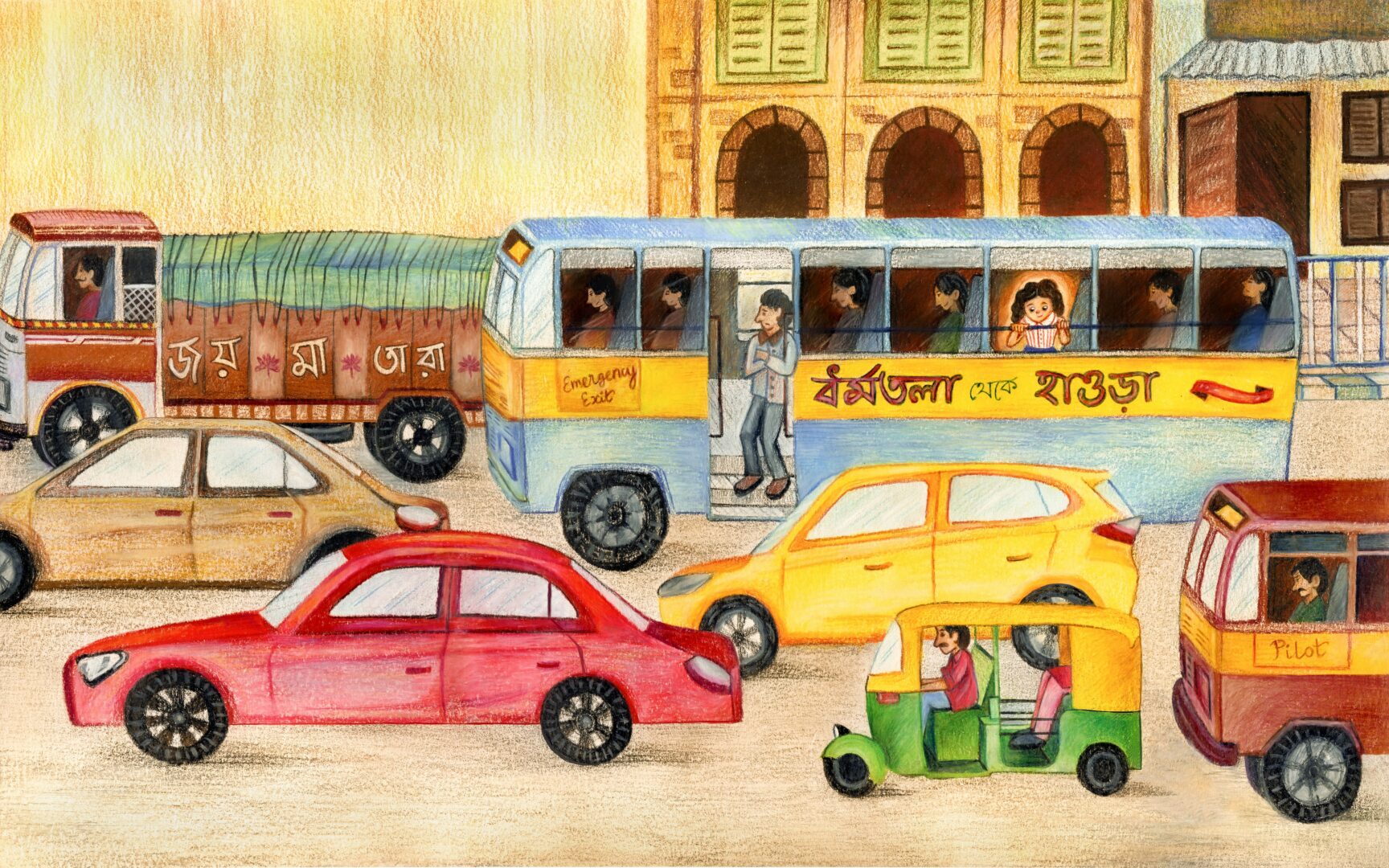
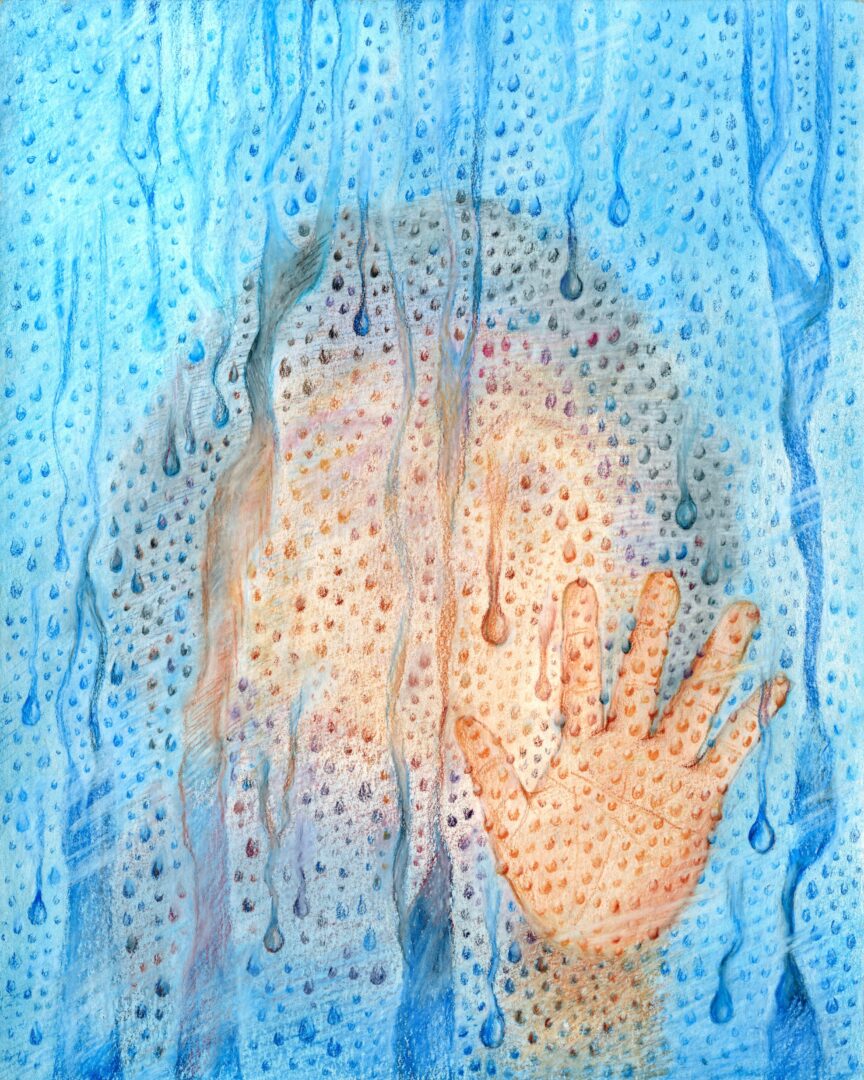
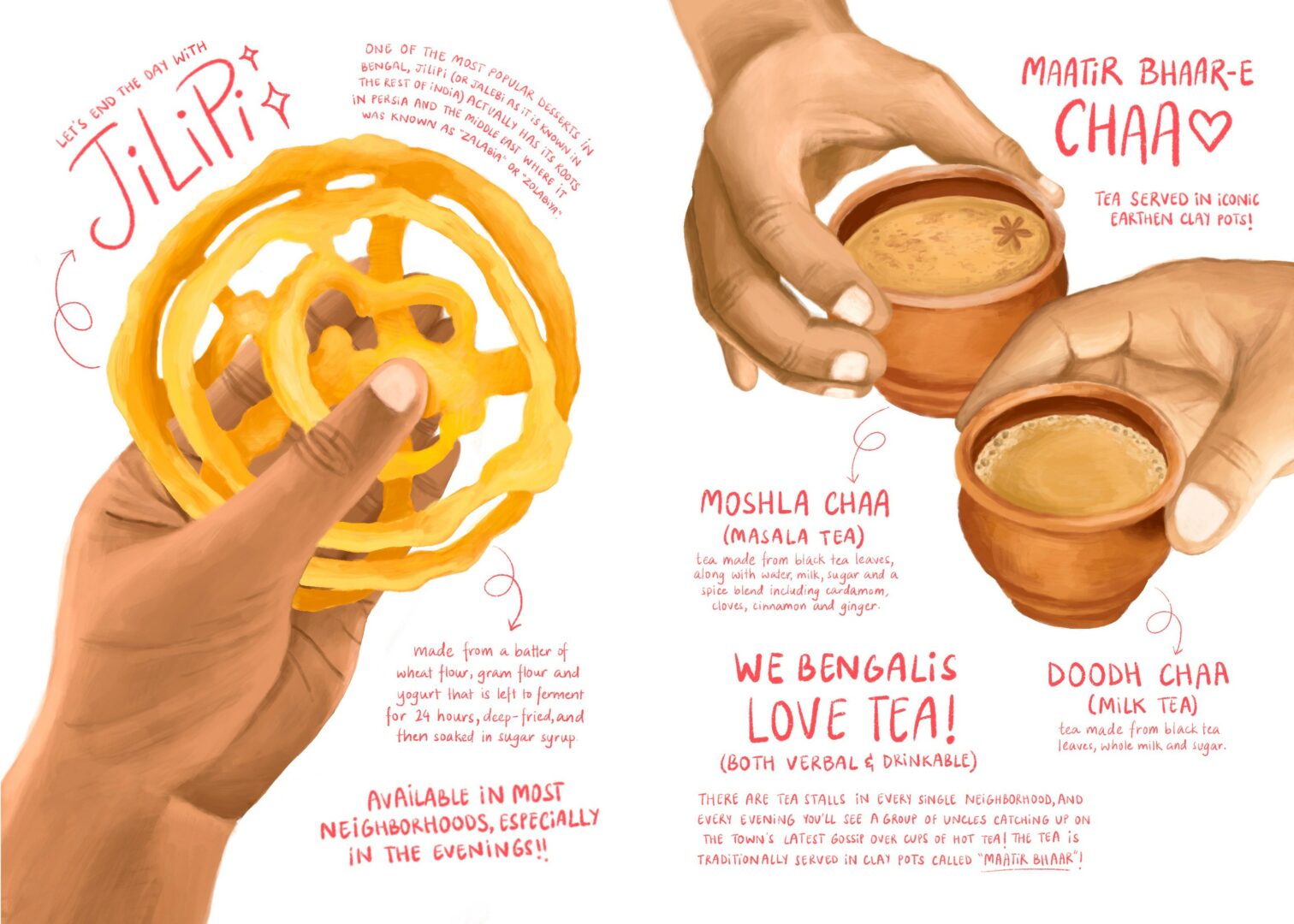
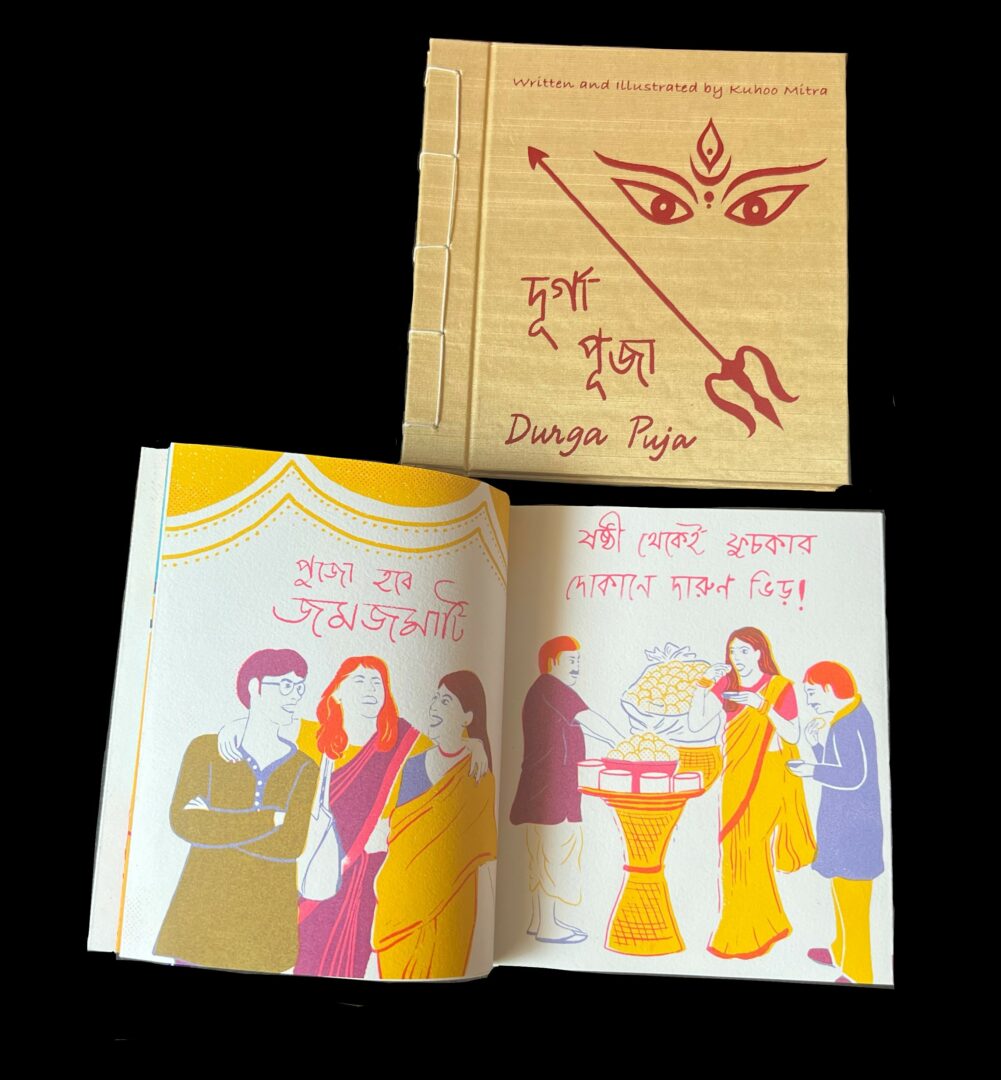
Some of my projects that I am proudest of are 1) a 15-page book about Durga Puja that I silkscreened, 2) a 16 page zine about the best street foods of Kolkata that I riso-printed, 3) “Brave Brishti” – a coming-of-age story about an eight-year-old girl navigating life in Kolkata. This was a 32-page picture book that I wrote and illustrated myself. The illustrations were done with watercolor, gouache and colored pencils.
While I love writing my own stories, I am also excited to collaborate with authors and publishing houses to illustrate books by other writers!
Looking back, what do you think were the three qualities, skills, or areas of knowledge that were most impactful in your journey? What advice do you have for folks who are early in their journey in terms of how they can best develop or improve on these?
The most important thing that furthered my artistic development was being open to critique and taking it seriously. Back during my first semester in art school, I used to be terrified of our critique sessions. I had absolutely no previous experience of standing in front of my entire class and talking about my work, only for it to be followed by endless questions and comments that dissected, analyzed and criticized my work. As the semesters went on, however, I understood that it was during these sessions, interacting with my peers and professors, listening to their interpretations of my work, answering their questions, pondering over their suggestions, and sometimes even arguing with them, that gave me the most insights about my own art and my own creative process. Now that I have graduated, when I make a new piece of art, I still ask my friends and other people around me for their opinions and insights. I have also learnt to take and trust critique not only from people in my field, but also from others, because my audience, the ones who will possibly read my books, or buy them for their children, will largely not be artists themselves. This is not to say that you should change your work based on the opinion of everyone around you. Rather, you should listen to everyone’s opinions with an open mind, and then you shall be able to make more informed decisions about your work.
My second point is largely related to the first. Learning from your peers. I credit so much of my artistic development to closely observing my classmates’ and friends’ works in art school, and asking myself what I could learn from them. The best way to be an artist is to constantly surround yourself with art. The walls of my room are full of prints and posters I’ve bought from my peers. Randomly someday I will look at one of them and go, “Wow! Those brushstrokes are so cool!” or “That texture is amazing. How did they do that?” Then, inspired, I will try it out myself. Sometimes, when I am painting together with my friends, even if we are using the same medium, we notice how differently we handle it. Often, I will observe a friend use a technique I’ve never used before and try it out for myself.
Lastly, I think having a good work ethic is very important. This includes finishing pieces you started, even if you don’t love them anymore. It also includes diligently doing the grunt work – research, thumbnails, sketches – before you get to the final piece. My favorite part of the process is definitely the part where I get to zone out, and not think about anything else, and only enjoy the feeling of putting paint and pencil on paper. However, it is the hours that are put in before this moment, the hours spent finding the right references, researching about the time period, setting or cultural context of the illustration, doing a dozen composition sketches and not liking any of them, so having to do a dozen more, that truly define what the final outcome is going to be.
As we end our chat, is there a book you can leave people with that’s been meaningful to you and your development?
As a child, I enthusiastically consumed all of the picture books my parents put on my shelves. And gradually, over the years, those picture books got replaced with newer books. The characters in the stories grew up with me, and eventually by the time I was in high school my room was cluttered with fiction, non-fiction, memoirs – basically anything I could get my hands on.
Maybe that is why I have such a strong connection with illustrating stories, why from such a young age I was so sure I wanted to illustrate picture books, why during all my years in art school I never once considered changing my focus to editorial illustrations, or graphic design, or fine art. Because it was in stories and books that I found myself – keep finding myself – when I am lost. When I feel like no one around me gets me, I know there is a book somewhere with a character that is going through something similar to me, and reading that book is going to help me make sense of the world around me.
It is hard to choose a single book that has inspired who I am. However, a writer I look up to as a source of inspiration is Amitav Ghosh. He is a Bengali writer from the same city that I am from – Kolkata. A lot of my knowledge about the history of Bengal, and colonialism in the Indian subcontinent, has come from reading his books. I love his writing because it does not conform to any pre-existing notions or stereotypes about what South Asian literature should discuss. He writes about communities, people, and periods in history that have almost been erased. I am inspired to similarly highlight forgotten and less talked about elements and stories from my culture in my work. Ghosh also experiments with a lot of different styles and genres of writing. Some of his works are fiction, others are non-fiction. Some are fantasy, some are magical realism, while others are absolutely grounded in reality. Creative professionals, especially artists, are often advised to develop a style, carve out a niche for themselves and stick to it. While I don’t completely disagree with this advice, as a very experimental person myself, it is refreshing and encouraging to see other people in creative fields simultaneously straddle many different genres. It gives me hope that in the future, I, too, can use a variety of different methods and mediums to tell my stories, instead of limiting myself to a single style.
Contact Info:
- Website: https://www.kuhoomitra.com
- Instagram: @kuhoomitra.art
- Linkedin: https://www.linkedin.com/in/kuhoo-mitra
so if you or someone you know deserves recognition please let us know here.