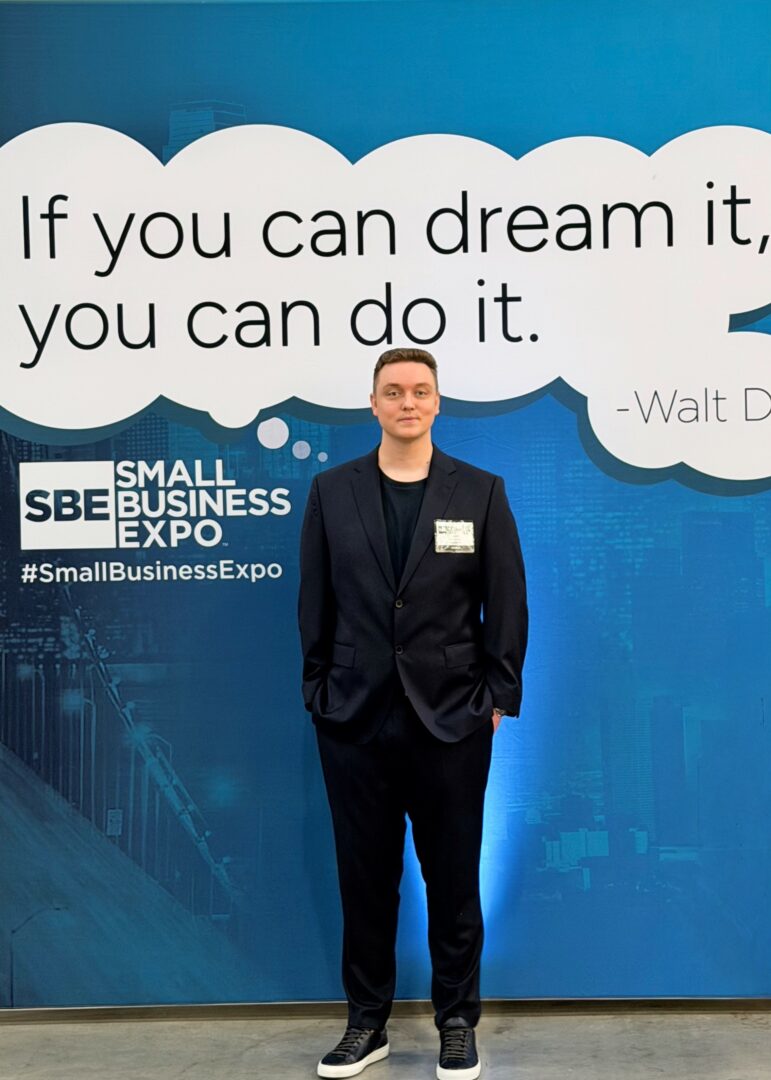
Valerii Khomynskyi shared their story and experiences with us recently and you can find our conversation below.
Valerii, we’re thrilled to have you with us today. Before we jump into your intro and the heart of the interview, let’s start with a bit of an ice breaker: What is a normal day like for you right now?
A “normal” day for me starts around 7 a.m. The first thing I do is mentally run through my task lists for the day: key priorities for our team, product milestones, and a few strategic things that can actually move the needle, not just fill the calendar.
I try to carve out time for my health and sports as consistently as possible. It doesn’t happen every single day, but I’ve learned that if I don’t deliberately schedule movement, the business will easily take 100% of my time and energy. Training clears my head and helps me make better decisions.
Most of my day is spent in communication with my team. We discuss what needs to be solved inside the company, unblock people, and adjust priorities. My main focus right now is TruckSync, our AI-driven logistics platform that helps carriers in the U.S. and Europe reduce empty miles, cut fuel costs, and lower emissions by optimizing routes and load matching in real time. We’re working on complex issues in transportation, from infrastructure impact to sustainability, and we’re actively advancing the project at the government level as well, through pilots and conversations with agencies and policymakers. I can’t share all the details yet, but we’ve already achieved meaningful results with several fleets and partners.
In parallel, I stay involved with Elite Biz Team, our consulting and strategic advisory company, where we help entrepreneurs structure their companies, navigate regulations, and scale internationally. So a typical day for me is a mix of product, strategy, and a lot of conversations about how to make business and transportation a bit more efficient and a bit more future-oriented.
Can you briefly introduce yourself and share what makes you or your brand unique?
My name is Valerii Khomynskyi, and I’m a tech entrepreneur and business strategist focused on using AI to solve real-world problems in logistics and infrastructure. I started my career in performance marketing, building campaigns where every dollar spent had to be tied to measurable results. That led to founding Piar Delux, a full-service digital agency working with clients across North America and Europe, and then Elite Biz Team, a consulting company that helps founders structure their businesses, scale internationally, and navigate regulations and growth strategy.
Today my main focus is TruckSync, a U.S.-based startup that uses artificial intelligence to optimize freight operations, reduce empty miles, cut fuel costs and emissions, and make trucking more efficient and sustainable in the U.S., Europe and beyond. We analyze telematics, route, and operations data in real time to help fleets and shippers move freight smarter, not just faster. My work sits at the intersection of AI, logistics, and policy: we’re not only building product, but also actively engaging with industry leaders and government stakeholders around critical infrastructure, data security, and the future of transport.
What makes my path a bit different is that I combine a background in marketing, analytics, and business development with hands-on experience in freight and technology. I care about ideas only when they can be backed by data and implemented at scale. That mindset has taken me from advising brands, to judging startup competitions, to leading TruckSync as we push for a more efficient and sustainable logistics ecosystem. At this stage of my journey, every project I work on has the same goal: create real value for people and businesses while contributing to a more modern, resilient transportation infrastructure.
Okay, so here’s a deep one: What breaks the bonds between people—and what restores them?
I think bonds between people usually don’t break because of one big dramatic event, but because of small things that are ignored for too long. At the core, relationships erode when trust is quietly replaced by fear, ego, or indifference. In both personal and professional contexts, this often shows up as people no longer feeling safe to be honest. They start editing themselves, hiding mistakes, or playing politics instead of working toward a shared goal. Once that happens, the connection is already damaged, even if on the surface everything looks “fine.”
In professional relationships, bonds break when people feel used instead of valued. When leaders treat people as resources instead of humans, communication becomes transactional, and so do the relationships. Misaligned expectations, broken promises, and the absence of clear principles also destroy trust. If someone consistently says one thing and does another, it doesn’t matter how talented they are; people will eventually distance themselves, mentally if not physically.
What restores bonds is almost the opposite: honesty, consistency, and a willingness to be vulnerable. Trust doesn’t return because someone gives a nice speech. It comes back through small, repeated actions: keeping your word, admitting mistakes, being transparent about motives and constraints, and showing that you care about the long-term relationship more than the short-term win. In teams, it’s built when people can disagree without fear of punishment, when feedback is direct but respectful, and when success is shared rather than claimed by individuals.
On a deeper level, connection is restored when people remember why they were together in the first place: a shared mission, shared values, or simply shared humanity. When we shift the focus from “Who is right?” to “What are we trying to build together?” it becomes much easier to rebuild bridges. In my experience, whether in business or in life, bonds are protected and restored by one simple principle: act in a way that you’d be proud of even if every conversation were recorded and replayed in ten years. That mindset creates the kind of integrity that relationships can survive on, even through conflict and change.
What fear has held you back the most in your life?
This will sound very common, but the fear that held me back the most was the fear that something wouldn’t work out and I’d have to start all over again. Not just losing money or a project, but the feeling that years of effort, reputation, and expectations would disappear overnight and I’d be “back at zero.” For a long time, that fear made me overthink decisions, stay longer than I should in “safe” situations, and delay launching or scaling ideas until everything looked perfect on paper.
The paradox is that almost every breakthrough in my life came from exactly those moments of “starting again” that I was trying to avoid. Changing direction in business, moving into new markets, switching from services to building products, going deeper into logistics and AI – all of that required letting go of what was already working and accepting that some things would fail. I realized that the real risk was not in failing, but in getting stuck in something that no longer matched my ambitions just because I was afraid to reset.
Over time I reframed this fear. Instead of seeing “starting from scratch” as a collapse, I started to see it as a restart with upgraded experience, connections, and understanding of myself. You never truly go back to zero; you go back with data. Now I still feel fear when I make big bets, but I use it more as a signal to prepare better, not as a reason to freeze. In entrepreneurship, the question is not “How do I avoid failure?” but “What’s worth failing for and learning from?” Once I accepted that, it became much easier to move forward despite the fear.
I think our readers would appreciate hearing more about your values and what you think matters in life and career, etc. So our next question is along those lines. What important truth do very few people agree with you on?
One important truth that very few people fully agree with me on is this: in most cases, “fear of failure” is just a socially acceptable mask for simple inaction and comfort. People rarely admit, even to themselves, that they are not doing something because it’s easier not to move than to move. So they wrap it in nicer language: “I’m not ready yet,” “The timing isn’t right,” “What if it doesn’t work?” In reality, very often it’s not a deep psychological block, it’s just a preference for stability and convenience.
I’m a strong believer in not looking for excuses for my own inaction. When someone says, “I don’t start this project because I’m afraid to fail,” my first thought is: are you really afraid, or are you just comfortable where you are? A lot of people are loyal to their current level of stability: this job works, this routine works, this system works, why should I risk it by trying something new or growing past it? The problem is that this mindset slowly kills curiosity, growth, and any chance of building something bigger than your current life.
From my experience in business and tech, progress almost always requires stepping into uncertainty before you feel fully prepared. You will never have perfect information, perfect timing, or perfect conditions. At some point you either act or watch someone else act and then explain to yourself why “it was not for you anyway.” I think the hard truth is that most people are much more capable than they allow themselves to be, but they trade that potential for the comfort of not having to test themselves. I try to live the opposite way: if I catch myself inventing reasons not to start, that’s usually the exact signal that I should.
Okay, so before we go, let’s tackle one more area. If you knew you had 10 years left, what would you stop doing immediately?
If I knew I had only 10 years left, the first thing I would stop doing is letting fear of risk slow me down, both in business and in life. A lot of decisions, especially big ones, come with unnecessary hesitation: “What if this doesn’t work? What if I lose time, money, or reputation?” With a clear 10-year horizon, I would cut that internal noise and double down on what I really believe in, even if the odds are uncertain. I’d still think strategically, but I wouldn’t give fear as much power in the decision-making process.
I would also stop wasting time in any form that doesn’t create real value: meaningless meetings, conversations that go nowhere, projects I don’t truly care about, and digital distractions that eat hours and give nothing back. Time is already the most limited resource; with a visible countdown, it becomes non-negotiable. I’d be much more selective about where my attention goes and who I spend it with.
Instead, I would focus on maximum self-realization: building things that matter, scaling ideas that have real impact, investing in relationships that are deep rather than superficial, and taking care of my health so that these 10 years are not just long on paper, but full in quality. In short, I’d stop living as if time is endless and start treating every year as something I actively choose how to use, not something that just happens to me.
Contact Info:
- Website: https://truck-sync.com/
- Instagram: https://www.instagram.com/valerii_khomynskyi/
- Linkedin: http://www.linkedin.com/in/valerii-khomynskyi-280467266
- Facebook: https://www.facebook.com/valerii.khomynskyi
- Other: https://elitebiz-team.com/
https://piardelux.com/
so if you or someone you know deserves recognition please let us know here.