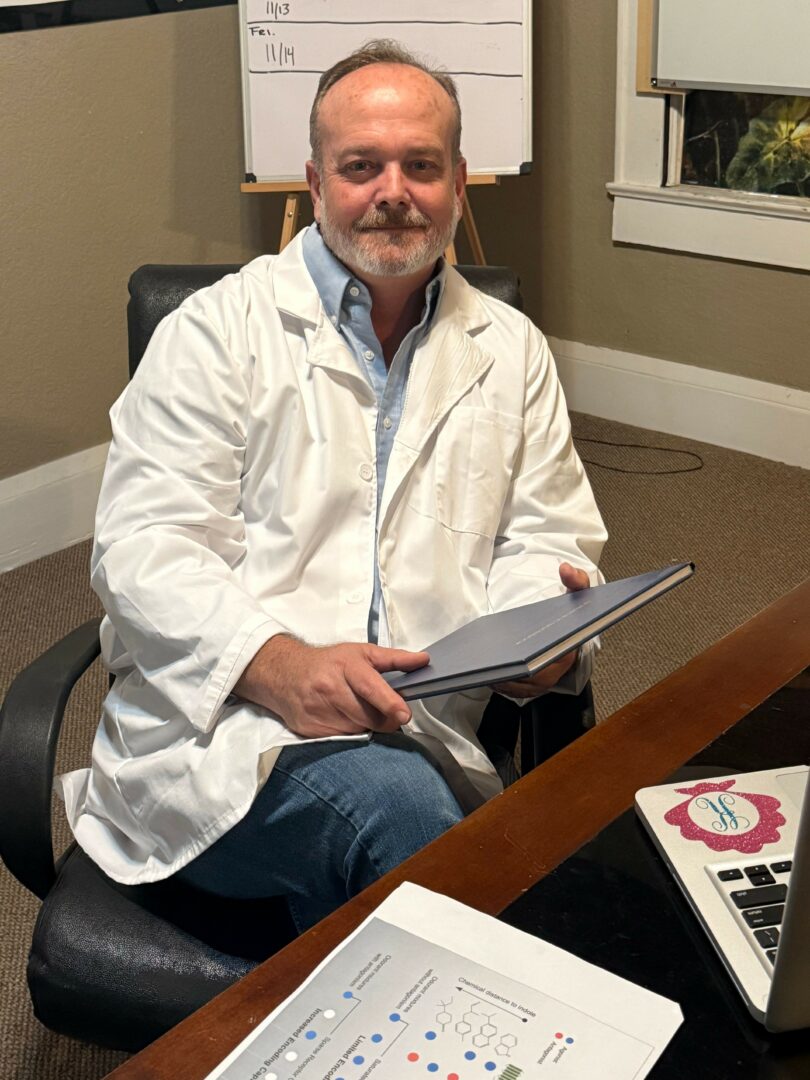
Daryl Thompson shared their story and experiences with us recently and you can find our conversation below.
Good morning Daryl, we’re so happy to have you here with us and we’d love to explore your story and how you think about life and legacy and so much more. So let’s start with a question we often ask: What is a normal day like for you right now?
I usually start my day around 5 AM. I go through international communications while I’m having my first cup of coffee, because many of our partners overseas send updates overnight. After that, I head downtown and take my golden retriever, Captain America, for about an hour-long walk. We always stop at the local coffee shop — it’s part of the ritual.
From there, I go into the office and meet with my colleague, Christina Glendening, for project updates and operational sync. Then I head back to my desk to review new mission requests coming in from various institutions. Around noon, I take a break for the gym — it resets my mind for the second half of the day.
The rest of the afternoon is spent advancing our active objectives. That can mean working with universities, corporations, or defense contacts. We shift between projects based on urgency, so in a single day we might move from biodefense to energy systems, drug development, consumer product engineering, or typical Red Cell operations.
After work, I like to cook a healthy meal and then retire to my den to study for a couple of hours. I usually go to bed early — the next day always starts early as well.
Can you briefly introduce yourself and share what makes you or your brand unique?
My name is Daryl Thompson, and I’m the Founder and Director of Scientific Initiatives for Global Research and Discovery Group, also known as GRDG Sciences. We operate at the intersection of advanced science, national security, and humanitarian technology. Our work often spans multiple fields at once—biodefense, drug development, energy systems, materials science, and functional consumer products. What makes us unique is that we function like a scientific Red Cell: we’re designed to move quickly, identify emerging problems before they escalate, and engineer unconventional solutions that larger institutions can’t reach as fast.
Over the years, our team has developed broad-spectrum antiviral platforms, next-generation antimicrobials, advanced cooling technologies, energy-efficient materials, and a wide range of inventions that support both civilians and defense partners. Many of our discoveries now operate under larger umbrella programs such as the Interceptor Program, which includes initiatives in survival systems, energy, biodefense, and global readiness.
What drives our work is a simple mission: create technologies that solve real-world problems and can scale to benefit as many people as possible. Whether we’re working with universities, corporations, or international organizations like the UN, NATO, or the WHO, the goal is always the same—innovate quickly, responsibly, and with impact.
Amazing, so let’s take a moment to go back in time. Who were you before the world told you who you had to be?
I think I’ve always been an explorer at heart. Long before titles, responsibilities, or expectations, I was that kid who wanted to understand how things worked and why the world behaved the way it did. I was drawn to the unknown—to the woods, the water, the Everglades, and later to the frontiers of science. Exploration, for me, was never just about geography. It was about pushing boundaries, asking harder questions, and being willing to go where the answers actually lived, whether that meant a lab bench, a remote jungle, or an unconventional idea most people hadn’t considered yet.
That sense of curiosity stayed with me. It’s ultimately what shaped my life’s work. Even today, everything I do—whether it’s biodefense, drug development, energy systems, or humanitarian technology—comes from that same internal compass I had as a kid: Look for what’s hidden, understand what others overlook, and build something that makes a difference.
What have been the defining wounds of your life—and how have you healed them?
One of the defining challenges in my life has been realizing how resistant the human race can be to innovation. You would think that better solutions, safer technologies, or more efficient systems would be embraced immediately — but in practice, progress often moves one step forward and two steps back. New ideas can disrupt established structures, and people don’t always welcome that disruption, even when it ultimately benefits them.
For a long time, that resistance felt like a wound. I saw technologies that could save lives delayed, misunderstood, or dismissed simply because they were unfamiliar or inconvenient. But over the years, I learned to approach that resistance not as a barrier, but as part of the process. Innovation isn’t just about invention — it’s about endurance, patience, and finding ways to communicate the value of something that hasn’t existed before.
How did I heal from it? By accepting that progress rarely follows a straight line. By surrounding myself with people who believe in the mission. And by focusing on the impact rather than the obstacles. At this point in my life, the resistance doesn’t slow me down — it clarifies why the work matters.
Sure, so let’s go deeper into your values and how you think. Is the public version of you the real you?
Not entirely. My work has required me to maintain a certain false façade for most of my life. Much of what I’ve done has involved Red Cell operations, national security work, and problem‑solving missions that can’t be discussed openly. For decades, even my own family didn’t really know what I did for a living. That wasn’t secrecy for secrecy’s sake — it was simply the nature of the work.
A clear example came during the emergence of COVID‑19. Long before the outbreak was public, my team was already working on intervention technologies. When the pandemic finally hit, some of that work surfaced in the press, and it led to a wave of public anger and misunderstanding. That experience reinforced what I already knew: when you’re dealing with high‑stakes, early‑stage threats, it’s better to stay quiet and keep working than to try to defend innovation in real time.
So the public version of me is only a small fraction of who I actually am. The real work happens privately, quietly, and often years before the rest of the world understands why it was necessary. And I’ve made peace with that. My goal has never been recognition — only results.
Okay, so before we go, let’s tackle one more area. When do you feel most at peace?
I feel most at peace in the Everglades. It’s not just a home—it’s a mentor, a teacher, and an endless source of inspiration. Growing up exploring its waterways and swamps, I learned early on that the Everglades has its own intelligence. The way water flows, the interplay of plant and animal life, the cycles of growth and decay—they all have lessons hidden in plain sight. Almost all of our discoveries at GRDG have, in some way, evolved from observing these systems. From biomimicry in materials to energy solutions, the Everglades quietly shows what’s possible if you take the time to really look and listen.
There’s a rhythm to the Everglades that you can’t find anywhere else—the wind whispering through sawgrass, the cypress knees standing like sentinels, the subtle calls of wildlife at dawn and dusk. It teaches patience, observation, and humility. When I’m out there, whether I’m paddling through a narrow channel at sunrise or walking along the banks with Captain, my golden retriever, I feel grounded in a way the modern world rarely allows. It’s a place where I can think clearly, see patterns, and reflect on problems in ways that inspire both creativity and innovation.
I wish more people could see what I see, because all the answers are there, if you know how to read them. The Everglades reminds me that true insight comes not just from data or theory, but from immersion, curiosity, and a willingness to learn from the natural world. That’s where I feel completely at peace—connected, inspired, and reminded that the world is full of possibilities waiting to be discovered.
Contact Info:
- Website: https://grdgsci.com/
- Linkedin: https://www.linkedin.com/in/daryl-thompson-a1674a6a/
so if you or someone you know deserves recognition please let us know here.