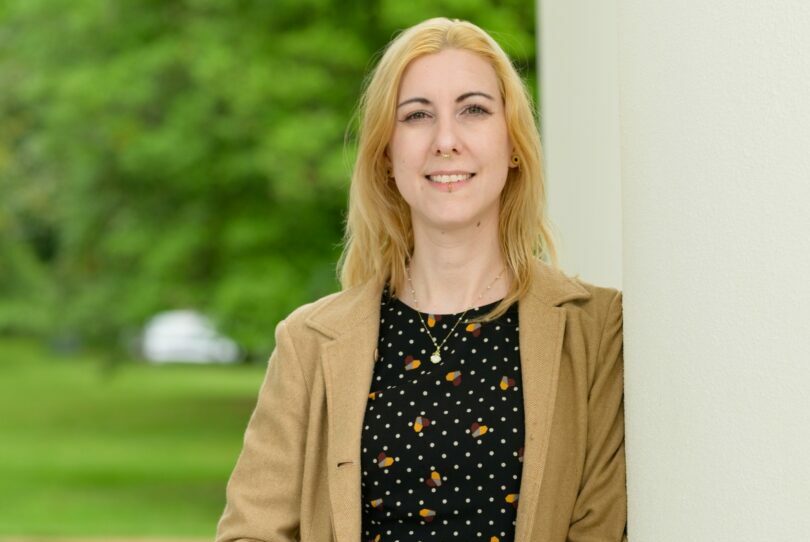
Stacy Braga shared their story and experiences with us recently and you can find our conversation below.
Good morning Stacy, it’s such a great way to kick off the day – I think our readers will love hearing your stories, experiences and about how you think about life and work. Let’s jump right in? What is a normal day like for you right now?
A normal day for me looks like waking up to an actual alarm clock (not my phone) and spending some time cuddling my cats. From there, I spend at least twenty minutes away from screens, getting ready for my day. If I’m lucky, I’ll spend some time playing an instrument, practicing yoga, or enjoying a quiet cup of coffee.
From there, I’ll start my workday by checking my calendar, email, and looking at my project management system to see what’s on the docket for the day. I generally start by checking in on my membership, Copy Classroom, to see if any members need support with copy reviews. Once that’s done, I’ll dive into whatever tasks I’m working on for that day.
Around lunch time, I’ll take a break and go for a walk outside. Sometimes I’ll make lunch, and other days I’ll dig into whatever leftovers I have from dinner the night before. When I’m back, I give myself a few focused hours of deep work. This is generally when I work on client projects like website copy or brand messaging guides.
I clock out around 4 pm on most days and will shift into some self-care, usually whatever I didn’t get to do in the morning. I’ll make dinner, hang out with my family, and end the day with some TV or video games.
It’s not super glorious, but it allows me a slower pace of life while still growing my business at a steady pace.
Can you briefly introduce yourself and share what makes you or your brand unique?
I’m Stacy Braga, a copywriter, messaging strategist, and former 2nd-grade teacher who helps service providers position themselves as the go-to choice for their industry.
I run Stacy Braga Copy Studio and Copy Classroom, where I get to blend my love of education, storytelling, and marketing to help business owners create messaging that feels honest, human, and clear. My work is about communicating the value service providers offer to their clients.
Thanks for sharing that. Would love to go back in time and hear about how your past might have impacted who you are today. What part of you has served its purpose and must now be released?
The part of me that’s ready to be released is the people-pleasing version of myself – the one that used to go above and beyond to over-accommodate to make everyone else more comfortable and avoid any criticism. As a former teacher, that was celebrated. As a business owner, I’ve learned to leave it behind.
As my studio and membership grew, I realized how much better everything felt when I set real boundaries and communicated expectations up front instead of shapeshifting to meet what I thought people wanted. People-pleasing helped me survive in earlier chapters of my life, but it doesn’t serve me anymore.
The more I’ve stepped into my role as a leader, collaborator, and strategist, the more I’ve learned that clients actually appreciate boundaries and clear communication. They appreciate the version of me who is confident, direct, and honest about what’s possible.
What did suffering teach you that success never could?
Suffering taught me something success never could: what I truly value in life.
I never imagined leaving teaching. I thought I’d retire after 35 years in a classroom, with hundreds of former students. But going through a really difficult season while teaching that led to burnout made me reevaluate what I wanted my life to look like. I couldn’t imagine putting three more decades of my life into a job that left me so drained.
Leaving wasn’t an easy choice. I’d invested so much into my career and my education. It felt like I was throwing away everything I had worked for. But I realized I needed something different if I wanted to live a more balanced, sustainable, and joyful life.
Now my version of success isn’t tied to student results or how much money I’m making. It’s having a work-life balance that allows me time with my family, time for boundaries, and time to explore what’s interesting. It’s choosing projects and clients who respect my time. It’s building a business that supports my life instead of consuming it.
Next, maybe we can discuss some of your foundational philosophies and views? Is the public version of you the real you?
Yes, the public version of me is real. It’s my voice, my opinions, my actual personality… the cozy copywriter who nerds out about messaging, marketing and leadership. But it’s also a curated version of me.
Even though I’m pretty active online, I’m intentional about what I share. You’ll never see my family in the spotlight. I’m not unpacking my trauma or turning my personal life into content. What I put out into the world is the part of me that’s relevant to my work — the educator, the strategist, the person who deeply believes in ethical marketing and clear communication.
I’m open, but I’m not exposed. And I like it that way. It keeps my work rooted in honesty without sacrificing my privacy, my relationships, or the parts of life that I don’t need documented online.
Okay, so let’s keep going with one more question that means a lot to us: What do you understand deeply that most people don’t?
What I understand deeply — in a way I don’t think most people do — is that empathy is what’s really behind great marketing. People often think copywriting is about persuasion or clever angles or getting someone to take action. And yes, that’s part of it. But the truth is, the most effective copy isn’t trying to convince anyone. It’s showing you understand where they are and where they want to go.
My background as a teacher taught me how to read between the lines, how to listen for what someone is trying to say but doesn’t have the language for yet. And that skill translates directly into messaging. When you can empathize with someone’s actual lived experience – their frustrations, hopes, anxieties, the emotions behind every decision – you don’t need gimmicks or manipulation – you can speak directly to them.
Empathy validates people. It helps them feel seen. And when someone feels understood, choosing to work with you becomes an easy, aligned decision — not because you “duped” them into buying, but because you articulated what they were feeling and showed them a clear path forward. The heart of ethical, effective marketing isn’t persuasion. It’s understanding.
Contact Info:
- Website: https://stacybragacopy.com
- Linkedin: https://www.linkedin.com/in/stacybraga/
- Other: Podcast: Cozypreneur: stacybragacopy.com/sustainable-marketing-strategy-podcast




Image Credits
Carrington Crothers, Nicole Connolly, Bianca Gonzalez
so if you or someone you know deserves recognition please let us know here.