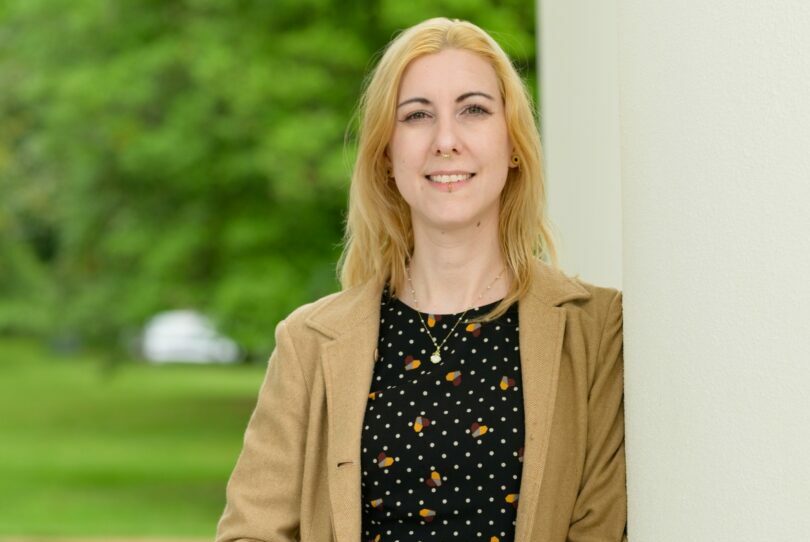
Danielle Epstein shared their story and experiences with us recently and you can find our conversation below.
Danielle, it’s always a pleasure to learn from you and your journey. Let’s start with a bit of a warmup: What is something outside of work that is bringing you joy lately?
I’ve recently gotten into Pilates and I’ve become obsessed! It is the perfect in-between, where I get the meditative, zen state of mind from something like Yoga but the physical challenge and intensity from weightlifting. Working from home as a solopreneur gets really lonely, so going to the studio and getting to socialize just adds to the joy of taking a Pilates class!
Can you briefly introduce yourself and share what makes you or your brand unique?
Hi, I’m Danielle, founder of The Intimate Instinct—a community and educational platform that helps people understand intimacy through a bio-psycho-social lens.
My work is rooted in a few simple truths. Intimacy goes far beyond sexuality and romance. It’s complex and nuanced—a place where safety and vulnerability coexist, trust runs deep, and resentment is absent. It shapes the quality of our relationships, which in turn determines the quality of our lives. And yet, most of us are never really taught how to foster it.
Instead, we piece it together through trial and error, from observing others, or from the over-romanticized (and often misleading) “Disney” version of love.
I came face-to-face with these hard truths in my late 20’s—blindsided by a partner’s cheating, utterly burned out from work, and completely disconnected from myself. It took me years of learning, reflecting, and resetting, to pull myself out of this slump. Now, I’m on a mission to help others shift from learning the hard way what not to do, to proactively learning what to do to foster intimacy and create more fulfilling relationships.
I am currently focused on building an online women’s group that blends research, storytelling, and discussion. Some weeks feel like a classroom, others like a fireside chat or even a debate. We explore topics such as masculine & feminine energy, hormones, and the cultural and historical forces that shape how we relate to one another—while actively disentangling these things from gender and stereotypes. My goal is simple: to give people the tools, language, and community support I wish I’d had during my own messy journey with love, friendship, and self-connection.
Great, so let’s dive into your journey a bit more. What’s a moment that really shaped how you see the world?
There are very few moments that truly changed the trajectory of my life. One of them came during a period of total upheaval, and was actually the genesis for The Intimate Instinct: I had just left my partner of eight years, sold my house, quit my job at Facebook, and blindly moved to a new town, hoping to start fresh.
About a week in, I met someone who casually asked about my story. I gave him the run down, and he stopped me cold with a comment I’ll never forget: “Facebook made you masculine, and that’s why your ex cheated on you.” His words caught me off guard. I was triggered, even angry. But he wasn’t trying to insult me—he genuinely wanted me to see something. So I stayed curious and asked him to explain.
He pointed out that I had become the sole provider and caretaker in my relationship, excelling at work while my partner struggled to even finish college. Then he added more layers to this: I was not only the younger one but also the female, which challenges societal norms for gender roles and expectations.
Somewhere along the way, our relationship dynamic shifted from being equal partners to something more like mother and son. For the first time, I really understood the saying “It takes two to tango.” The more I stepped into my mothering role, the more passive my ex became. And the more he retreated, the more hyper-independent I became. At work, I thrived by being assertive, outspoken, and competitive. At home, I couldn’t turn this energy off—and the softness I craved felt further and further out of reach.
We fell into a negative self-reinforcing cycle that neither of us knew how to break, and eventually that gap grew so large that infidelity forced us both to face what was happening. My new friend made it clear—none of this justifies the cheating, but it sure does explain it.
That conversation cracked something open for me. It was the first time I was introduced to the framework of masculine and feminine energy, and suddenly, so much made sense. I dove headfirst into studying it—first in my own life, then in my friends, family, and even the shows I watched. It changed the way I see relationships forever. Once you see those dynamics, you can’t unsee them.
If you could say one kind thing to your younger self, what would it be?
You’re different—and that’s more than okay. Your wisdom will feel older than your years, and your honesty will be more than some people can hold. You’ll give more care than you’ll often receive, and that imbalance will ache. Making friends won’t always be easy, but the ones who find their way into your world will discover a rare depth of friendship.
You were born to walk against the grain. At times, that path will feel lonely. But trust me—your difference is your gift, and it will one day become the very thing that lights the way for others.
Sure, so let’s go deeper into your values and how you think. What do you believe is true but cannot prove?
One of the biggest misconceptions about masculine and feminine energy is that masculine = male and feminine = female. I’d like to encourage you to think about it this way instead: masculine = traits associated with hormones that men typically make more of, and feminine = traits associated with hormones that women typically make more of.
For example, men usually produce more testosterone and vasopressin than women. These hormones are associated with behaviors like competitiveness, protectiveness, and territorialism—traits we often associate with masculinity. On the other hand, women typically produce more estrogen and oxytocin, which support creativity, empathy, and social bonding—traits we often associate with femininity.
Everyone has their own unique hormone profile, and therefore their own unique balance of masculine and feminine energy.
Before we go, we’d love to hear your thoughts on some longer-run, legacy type questions. How do you know when you’re out of your depth?
I’m out of my depth a lot in the work I do. My company is so interdisciplinary—we dive deep into topics ranging from biology and psychology to culture and relationships, and sometimes we look across multiple areas to see how they connect. No human could be an expert in all of it.
I know I’m out of my depth when imposter syndrome hits hard and I feel the urge to read and learn absolutely everything I can. In those moments, I remind myself that my role is to be a generalist—and that’s okay. Society often glorifies specialization and makes generalists feel inadequate, but my strength is seeing the bigger picture and connecting the dots. When the urge to master everything becomes overwhelming, it’s usually a signal to find someone with deep expertise in that area and partner with them.
Contact Info:
- Website: https://theintimateinstinct.com/
- Instagram: https://www.instagram.com/theintimateinstinct/
- Linkedin: https://www.linkedin.com/in/epsteindanielle/
- Facebook: https://www.facebook.com/profile.php?id=61560911590516


so if you or someone you know deserves recognition please let us know here.