We’re looking forward to introducing you to Scott Isenbarger. Check out our conversation below.
Good morning Scott, we’re so happy to have you here with us and we’d love to explore your story and how you think about life and legacy and so much more. So let’s start with a question we often ask: What makes you lose track of time—and find yourself again?
When I’m deeply engaged in my nightly studio practice, the loss of time is driven entirely by the problem-solving that is occurring on the canvas. It can be a rather sudden lapse, but most often is a gradual, deliberate narrowing of focus onto a specific visual challenge—getting the foreshortening of an arm right, achieving the perfect temperature in a shadow, or correcting a proportion that is subtly off. The physical action of mixing and layering the paint becomes a rhythmic meditation and pleasantly hypnotic. I am no longer thinking about the work, I am simply in the flow of making it, absorbed in the immediate back and forth of Dionysian action and Apollonian reflection. Hours vanish because my attention is tethered to the pursuit of the elusive moment when the painting “clicks.” I find myself again when the sharp, persistent ache in my wrist or lower back demands a halt. Alternatively, I might step back to assess the work and notice the subtle accumulation of small signs: the palette is covered in dried paint, the studio floor is littered with dirty rags, and the simple fact that my mental stamina is exhausted. The work no longer progresses with the same intensity. That feeling of hitting a wall—where the next stroke is forced rather than felt—is the clear signal to stop, step away, and return to the temporal world.
Can you briefly introduce yourself and share what makes you or your brand unique?
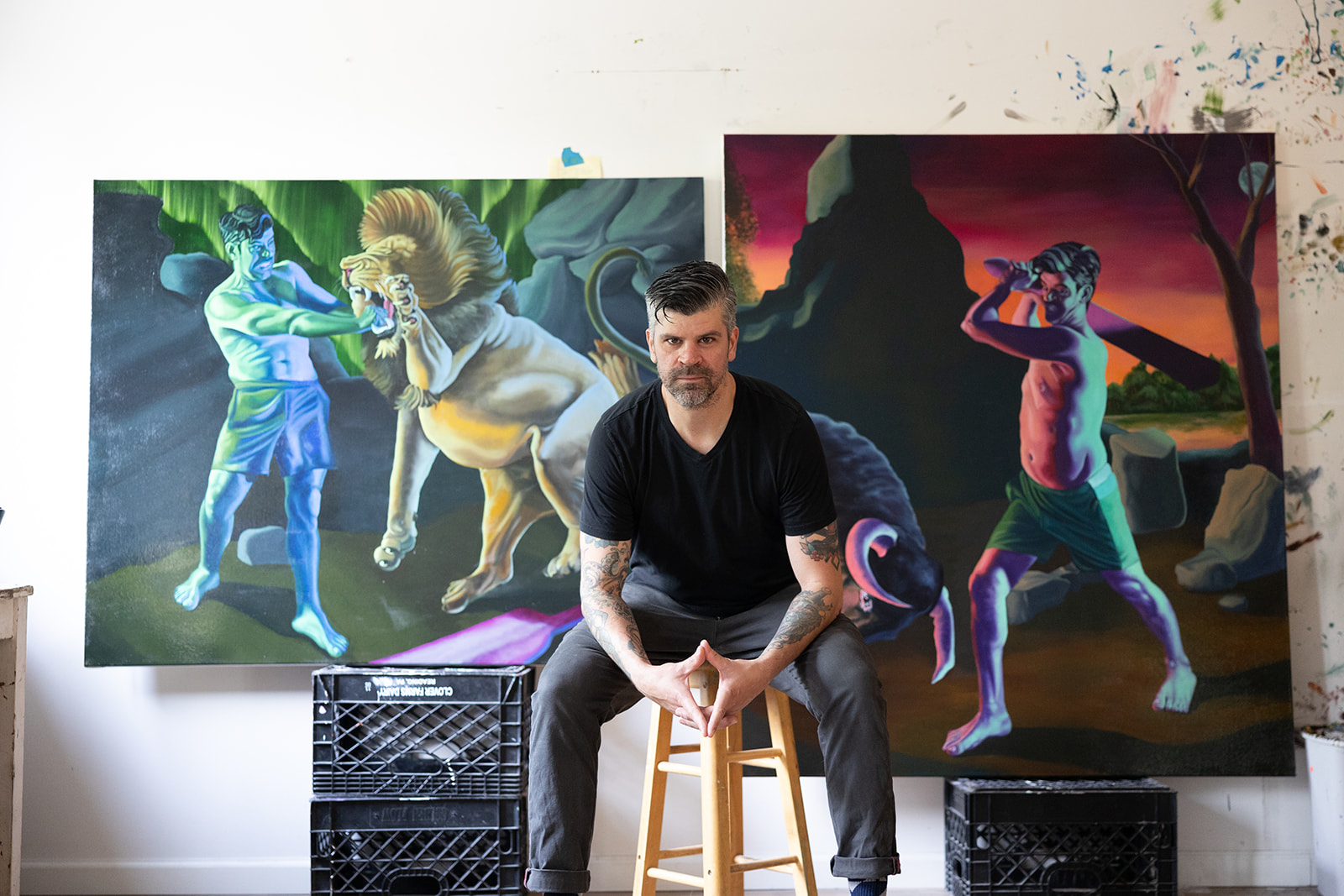
Based in the Hudson Valley, New York, I am a painter whose large-scale figurative canvases offer a vibrant and surreal commentary on art history. My academic background, cemented by a BFA from Indiana University and an MFA from the San Francisco Art Institute, grounds a practice focused on deconstructing and re-contextualizing antiquated themes. My work is visually arresting, utilizing a bold, colorful palette to subvert historical narratives and turn patriarchal tropes on their head. My most recent body of work specifically reexamines traditional ideas of masculinity and redefines them in complex, modern terms. What makes my paintings distinct is my frequent self-insertion into these grand, operatic scenes. By placing my own figure directly into the allegorical compositions of the past, I not only implicate myself in the narrative but also actively write my own identity into the canon of art history, asserting a contemporary claim to these historically exclusive visual spaces.
Okay, so here’s a deep one: Who were you before the world told you who you had to be?
Before I hit seventeen, my identity was entirely functional: I was an athlete. My life had a simple, clear trajectory dictated by two sports, and my future was mapped out for college football and basketball, leading to a practical career in a sports-related field. The world didn’t have to tell me who to be; it simply reinforced what I already felt, that my purpose lay in my physical drive and competitive performance. That clear track ended abruptly when a severe staph infection settled in my pelvis requiring intense surgery and recovery. It wasn’t just physical pain; it was the sudden, complete deletion of my momentum and blunt facing of one’s own mortality. When you can no longer move, train, or compete, the rigid structure of being a prospect collapses, leaving a profound void. The long, forced stillness of recovery wasn’t a choice, but it allowed me to fall back into my other, earlier interest, which was art. I approached making and studying old masters with the same intensity I used to have for a two-a-day practice. I quickly realized the discipline wasn’t new, the intense focus required to master perspective or color theory was the exact equivalent of the discipline required to master a free throw. The injury didn’t make me discover a new self, it simply removed the external expectations, forcing me to recognize that the pursuit of art, the desire to create and express, was where that powerful commitment truly belonged, redirecting me from the practical path to a wholly satisfying creative one.
What did suffering teach you that success never could?
The forced change in my life trajectory, initiated by a severe staph infection at seventeen, offered lessons that athletic success could never deliver. Success, in my previous life, was all about momentum and external validation; it rewarded me for conformity and performance on the field. The illness enforced a radical stillness, stripping away that public identity and forcing a profound, internal reckoning. Success had told me my value was in my strength and speed, but suffering taught me my inherent worth was separate from my physical output, allowing me to finally acknowledge the genuine, self-sufficient desire to pursue art. The slow, meticulous process of recovery replaced fast, reactive training, giving me the patience for detailed observation—a focus essential for painting that my previous life of constant motion would have always overlooked. Ultimately, athletic discipline was transactional, geared toward winning; the discipline forged during my hardship was the discipline of enduring and creating even when unseen. Suffering didn’t just end a planned life; it shattered the external structure and revealed the enduring architecture of my own desire, redirecting my commitment from a physical game to the profound, quiet satisfaction of giving form to an idea.
So a lot of these questions go deep, but if you are open to it, we’ve got a few more questions that we’d love to get your take on. What are the biggest lies your industry tells itself?
The biggest lie the art world tells itself is the myth of meritocracy. It insists that quality, talent, and aesthetic brilliance are the primary, objective drivers of success; that the most deserving artists naturally rise to the top. In reality, the commercial art world is a deeply subjective, gatekept system driven by speculative finance, social capital, and institutional networking. While skill is a prerequisite, it’s often the narrative of scarcity, the endorsement by a handful of powerful curators and dealers, and the wealth of collectors that determine who becomes a market phenomenon, not just the work itself. This lie of pure merit not only excuses the system’s massive economic inequalities, but it also provides a convenient moral framework for the exclusion of countless talented artists who lack the right educational pedigree, geographic location, or network connections. By clinging to the notion of quality as the sole metric, the art world avoids confronting the fact that its market values are heavily influenced by class, systemic bias, and the self-fulfilling prophecy of institutional consensus.
Okay, so before we go, let’s tackle one more area. What are you doing today that won’t pay off for 7–10 years?
What I am doing today that won’t pay off for 7-10 years is the quiet, demanding work of building a durable body of work and a distinct language. In the studio, I am pouring large amounts of time and financial resources (pigments, canvas, energy) into paintings that challenge art historical norms and reexamine masculinity. This process is inherently a long-term investment. Unlike the market-driven trends of the moment, a truly sustained artistic career isn’t built on immediate sales or fleeting gallery buzz, but on the intellectual rigor and aesthetic coherence that comes from hundreds of hours spent in deep, unhurried pursuit. I am laying down the foundational layers, both literally on the canvas and conceptually in the development of my unique voice, which will make the work relevant and resilient a decade from now. The payoff won’t be in the quick gallery sale, but in the eventual institutional recognition and the enduring critical dialogue that only comes when a complete, cohesive vision has had the time to mature, assert itself, and claim its space in the art history I am actively trying to join.
Contact Info:
- Website: https://www.isenart.com
- Instagram: isenkunst
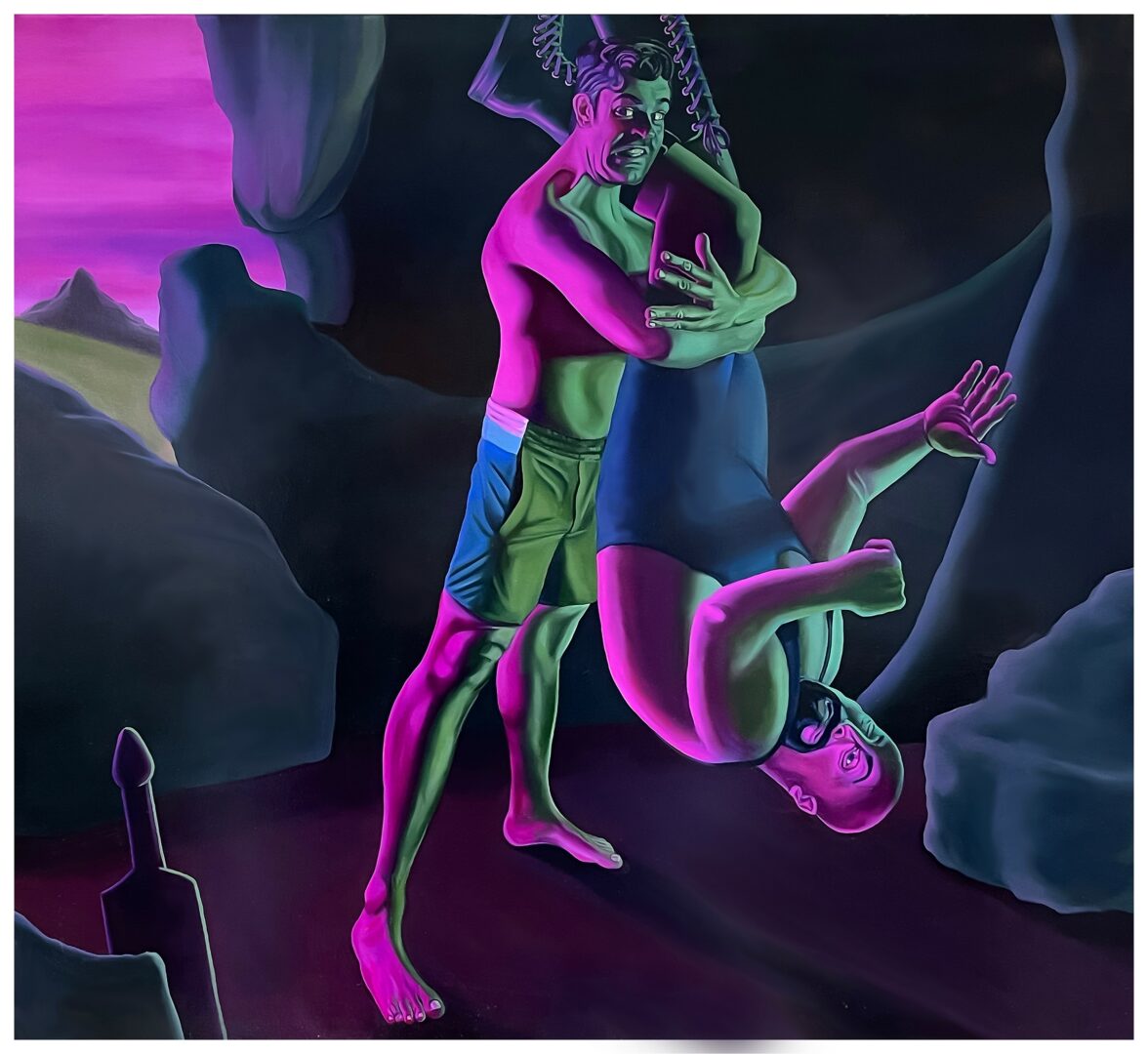
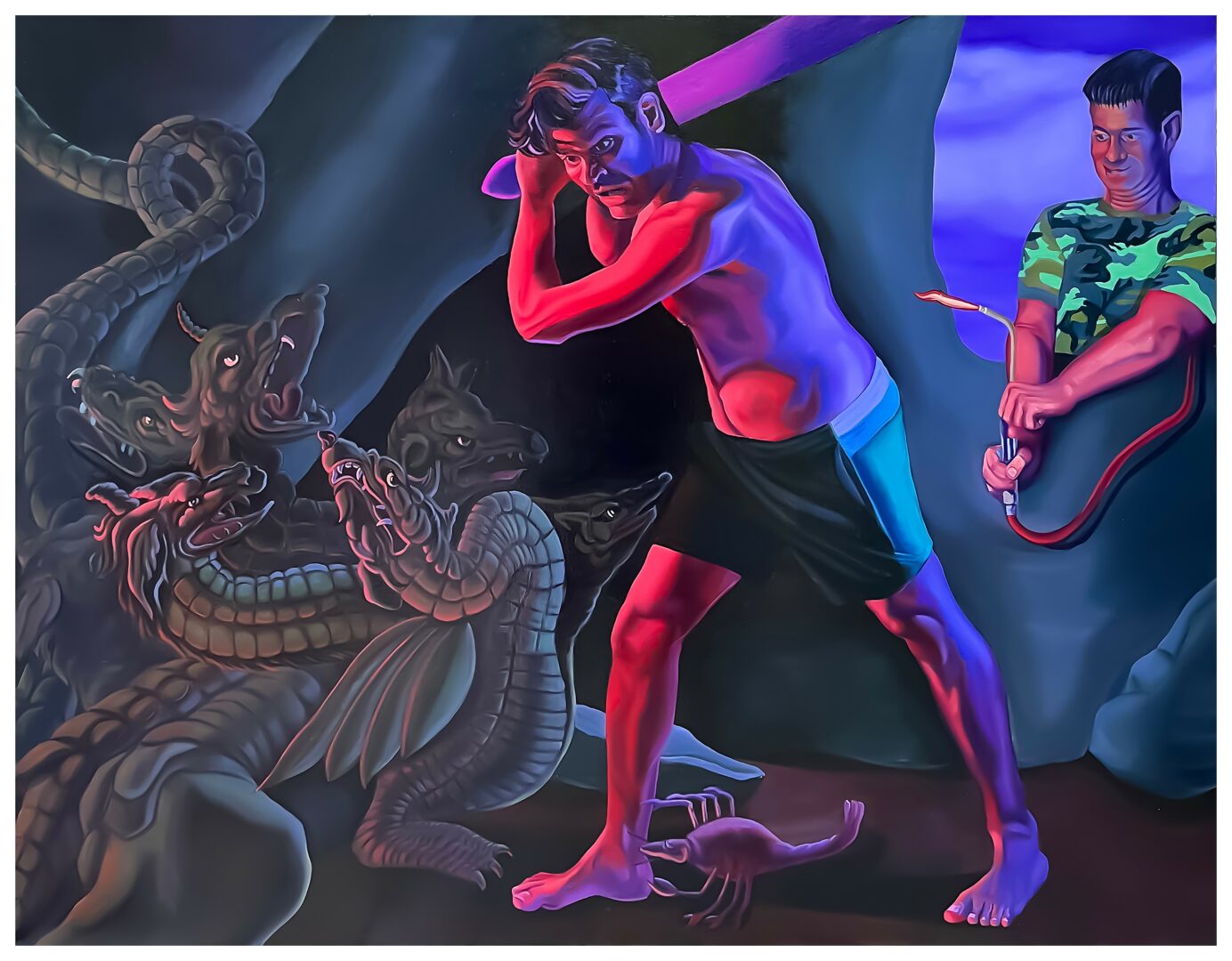
Image Credits
photo of artist in the studio provided by: Yumi Matsuo
photos of artwork taken by me 😉
so if you or someone you know deserves recognition please let us know here.