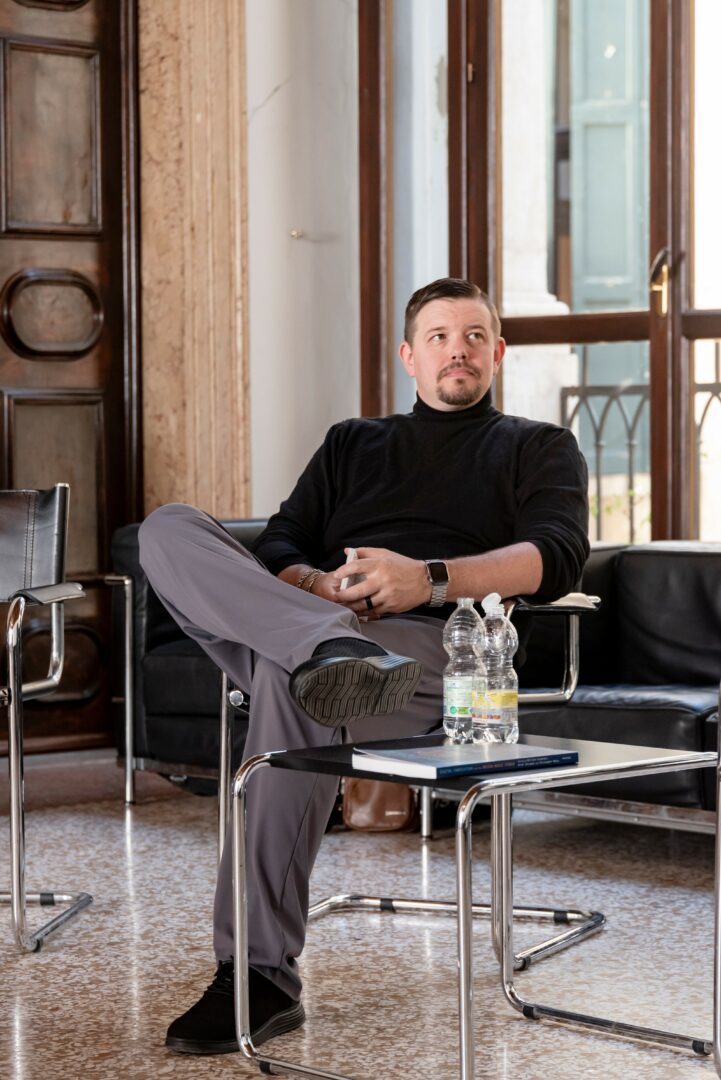
We were lucky to catch up with Chad Reineke recently and have shared our conversation below.
Alright, so we’re so thrilled to have Chad with us today – welcome and maybe we can jump right into it with a question about one of your qualities that we most admire. How did you develop your work ethic? Where do you think you get it from?
I grew up in a family where nothing came easy. My parents were young—just kids themselves—and we didn’t have much. There was no safety net, no inherited roadmap, no quiet guarantee that things would work out. What we did have was this unspoken understanding that if you wanted something, you showed up, you stayed with it, and you worked until the job was done.
For me, that became less a lesson and more a survival skill. Early on, I learned that talent only gets you through the door; consistency keeps you there. Architecture reinforced that. Studio culture, teaching, construction—it’s all about attention, discipline, and the willingness to sit with problems long enough to understand what they’re really asking of you.
My work ethic also comes from wanting to create a different trajectory for my children. I want them to see that you can build a life through presence and persistence—not by being the loudest voice, but by being the one who keeps showing up with integrity.
And honestly, part of it comes from mentors who modeled the long game: that architecture isn’t instant gratification; it’s endurance. It’s patience. It’s caring enough about the work to do it even when nobody sees the effort behind it.
If I had to sum it up: my work ethic comes from growing up without privilege, choosing a discipline that demands devotion, and wanting my life—and my work—to be something my kids can stand on.


Thanks, so before we move on maybe you can share a bit more about yourself?
I’m an architect, educator, and writer, and today I serve as the Chief Operating Officer at Lightroom, an architecture studio based in Decatur, Georgia. I also work as a Senior Project Architect with Sponseller Group Inc., where I lead complex industrial and commercial projects across the country. Balancing work in two very different architectural environments—one rooted in design culture and research, the other in technical precision and large-scale coordination—has made me sharper, more adaptable, and more attentive to how buildings actually come together.
Across all of this, my day-to-day spans a wide range: designing buildings, mentoring younger architects, teaching, leading teams, and shaping the long-term direction of the firm. But the unifying thread is this: I’m deeply interested in the way architecture shapes how we feel, how we move, and how we understand the world around us.
What’s exciting about my work is that Lightroom is a studio built on attention and care. We’re not chasing trends; we’re trying to create spaces that feel grounded, honest, and present. Our projects range from homes and adaptive-reuse work to installations and exhibitions, but the philosophy stays the same—architecture should sharpen your senses, not overwhelm them.
We’re also in a meaningful moment as a practice. Lightroom exhibited at the Venice Biennale recently, and that experience reinforced something essential for me: architecture is not just technical problem-solving; it’s a cultural act. It’s a way of contributing to a larger conversation about how people live, learn, gather, and heal. That work pushed us to think more deeply about material, atmosphere, and the quiet, human side of design.
Alongside practice, I’m writing two books—Rules of Practice and Practice and Presence. Both explore ideas that have guided my career: the ethics of the studio, the value of mentorship, and the belief that architecture is really a discipline of attention. In many ways, the writing and the design work feed each other.
Lightroom is also expanding its community presence. I’m working with a local outreach program and the Boy Scouts of America to create architecture-focused workshops and badge programs for young people. The goal is simple: open the door to design, especially for students who might never see themselves in this field.
So at its core, my work is about building things—buildings, yes, but also people, ideas, and opportunities. The most exciting part is that it all feels connected: teaching informs practice, research informs design, and community work gives the whole thing purpose.
If readers know anything about my work, I hope it’s this: architecture is not just about creating structures—it’s about creating conditions for people to live better, more attentive lives.


There is so much advice out there about all the different skills and qualities folks need to develop in order to succeed in today’s highly competitive environment and often it can feel overwhelming. So, if we had to break it down to just the three that matter most, which three skills or qualities would you focus on?
When I look back at my career, three qualities have made the biggest difference: attention, endurance, and humility. None of them are glamorous, but they’ve shaped everything about how I work.
1. Attention
Architecture taught me that paying attention is a skill, not an accident. Whether you’re in studio, on a jobsite, or sitting with a client, the ability to actually see—to notice the detail everyone else ignores—becomes your most reliable tool.
My advice: Slow down enough to observe. Don’t rush past the problem because the solution feels uncomfortable. The best designers I know are the ones who look the longest.
2. Endurance
Nothing in this profession happens quickly. Projects take years, careers take decades, and the work asks you to keep going long after the initial excitement fades. Endurance isn’t about grinding yourself into the ground—it’s about staying with a pursuit long enough for it to reveal its depth.
My advice: Get used to the long game. Build routines, protect your time, and learn to work consistently on the days when you’re not inspired. That’s where progress really happens.
3. Humility
Architecture is collaborative. It’s technical. It’s unpredictable. Humility keeps you open to learning and grounded enough to ask questions before you need rescue. Some of the most important breakthroughs in my career came from admitting what I didn’t know.
My advice: Find mentors, ask questions early, and treat every project as a chance to expand your understanding. Nobody succeeds in this field alone.
If you’re early in your journey, focus less on mastering everything at once and more on developing these three capacities. Skills and software will change; the profession shifts constantly. But attention, endurance, and humility will carry you through every phase of your career—and they’ll make the work richer, steadier, and far more meaningful.


Okay, so before we go we always love to ask if you are looking for folks to partner or collaborate with?
Absolutely. Architecture is a collaborative discipline, and the work becomes stronger when you engage with people who bring different skills, perspectives, and energies to the table.
At Lightroom, we’re always interested in connecting with thoughtful collaborators—designers, artists, engineers, fabricators, educators, researchers, and community organizations who care about craft, clarity, and the human side of architecture. We gravitate toward people who value process as much as outcomes, and who see design as a way of contributing to culture rather than just producing a product.
I’m also personally interested in partnering with people in the education and youth-outreach space. I’ve been developing architecture workshops with a local outreach program and the Boy Scouts of America, and I’m always open to working with individuals or organizations who want to help young people understand design as a tool for agency and imagination.
If someone reading this wants to collaborate—whether it’s a project, a workshop, a publication, or even just a conversation—they’re welcome to reach out. The easiest way to connect is through Lightroom’s website at www.lightroom.tv
, where my contact information is available. I’m always open to meeting people who care about the work and want to build something meaningful together.
Contact Info:
- Website: https://www.lightroom.tv
- Facebook: https://www.facebook.com/profile.php?id=100063582160698


Image Credits
AIA Georgia
Matteo Losurdo
S House
so if you or someone you know deserves recognition please let us know here.