We were lucky to catch up with Mingxin Cheng recently and have shared our conversation below.
Hi Mingxin, thanks for sharing your insights with our community today. Part of your success, no doubt, is due to your work ethic and so we’d love if you could open up about where you got your work ethic from?
I believe my work ethic stems from my passion for creating thoughtful and impactful designs. Today, the rapid development of technology has transformed how people receive information, with digital screens dominating the advertising landscape. This shift brings both opportunities and challenges in ensuring accurate and honest information.
It raises the question: what kind of message do I want to deliver through my work? At the beginning of my career, I was driven by the desire to create visually appealing and attractive designs. However, I soon realized that attractiveness in design can have varied implications. For example, making certain words larger to distract from a tiny disclaimer or using images that highlight a model’s curves rather than the product itself can be manipulative.
That’s when I understood that I want to design with my audience in mind, rather than manipulating them to trust the screen and products. I aim to understand my audience’s needs and focus on their emotions. I believe that design should not be a tool for manipulation but a medium for meaningful communication. I strive to create designs that people enjoy, giving them a moment to pause and think, rather than being overwhelmed by aggressive and fear-driven messages.


Thanks, so before we move on maybe you can share a bit more about yourself?
It has always been my passion to transform ideas into visual storytelling through diverse styles and media. That’s why I chose to become a graphic designer and motion designer. In today’s design industry, while 60% of graphic design students are women, only 11% of women hold leadership positions in the field. This stark underrepresentation of women in senior roles highlights a significant disparity. It is my dream to be part of the team changing that statistic. As a female designer, I want to add my voice to the industry and the world. My personal works often reflect my expressions of emotion, the sense of loneliness and isolation, unforgettable grief and loss, and women’s rights.
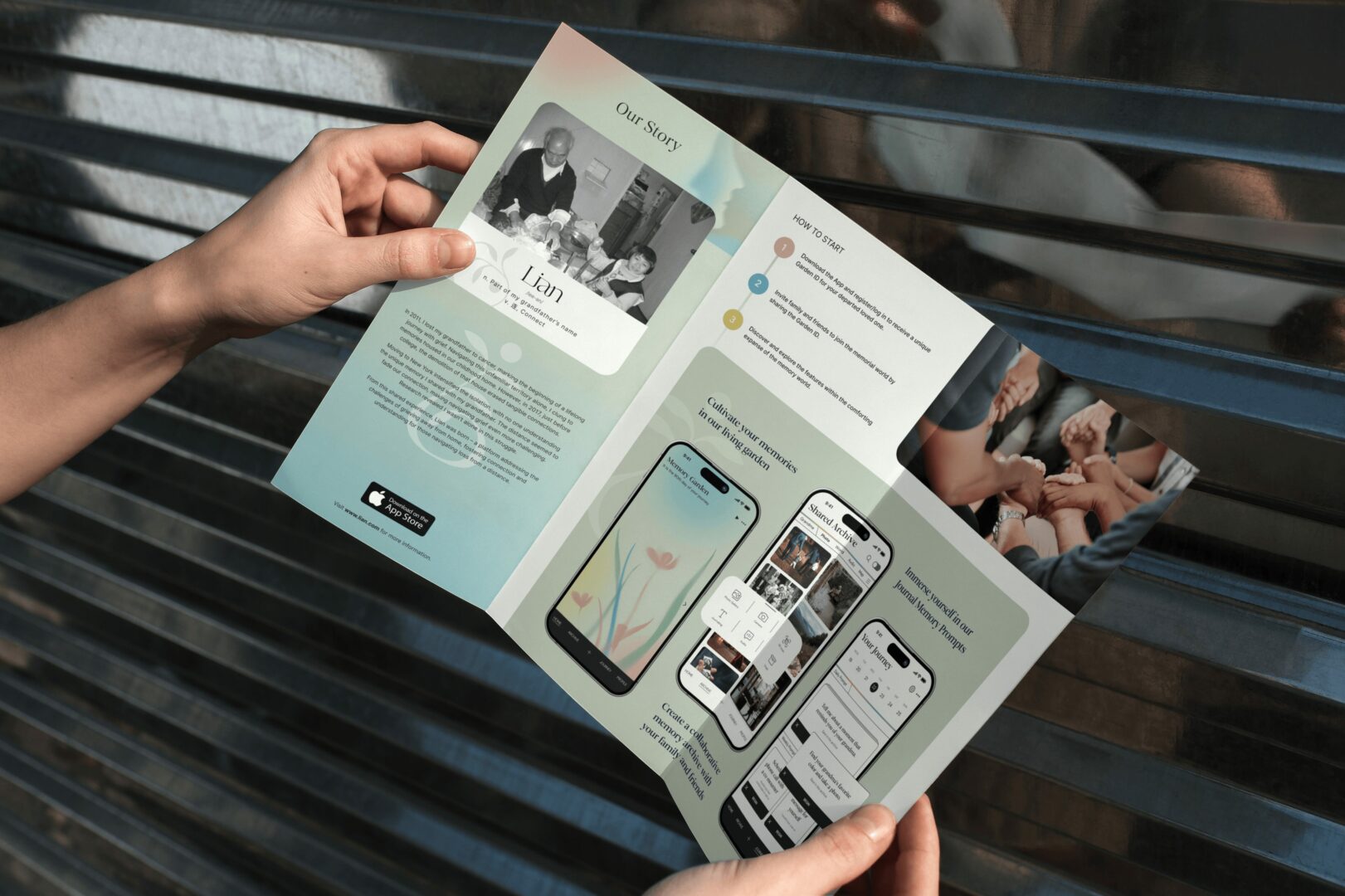
For my master’s thesis project, I studied the field of grief and loss and created Lian, a memorial platform inspired by my grandfather. The name Lian is part of my grandfather’s name and also means “connect” in Chinese. Lian is a memorial platform that journeys with grievers and their co-mourners to document memories and feelings, turning grief into a connection of life. In today’s mobile and fragmented society, dealing with grief and loss while away from home is increasingly common. Distance complicates the experience of care, bereavement, and grief. Lian creates a shared memory world that travels with grievers, connecting them to their co-mourners wherever they are. Through the Living Memory Garden, Collaborative Memory Archive, and Journal Memory Prompts, Lian helps facilitate a smoother transition between the funeral and fading group support, inspiring grievers to capture connections with departed loved ones in the present. My project is still in its early stages, but I want to encourage people to talk about unseen, complicated grief in the immigrant, international student, and traveler communities.
My voice is still small as a designer, but I want to create designs that touch people’s hearts and make a small difference in the world.

Looking back, what do you think were the three qualities, skills, or areas of knowledge that were most impactful in your journey? What advice do you have for folks who are early in their journey in terms of how they can best develop or improve on these?
First, observe the world outside of the screen. No matter how high-resolution a digital image is, your eyes can always sense more when you take a good look at the real world. The shape of tree shadows, the texture of building bricks, the colors of the sunset—there is so much random beauty in our lives that you will miss if you always stare at a screen. These observations inspire my artwork, and there’s always something out there to inspire you.
Second, find something small and easy that brings you happiness. For me, it’s watching crime TV shows and drinking milk tea. I’ve trained myself to use these as triggers to relax and forget about anxiety. It might sound simple, but having something easy and small to boost your energy and happiness can be very effective when facing pressure and anxiety. Often, tasks seem harder because we let fear and anxiety overwhelm us. During those times, a small trigger can help distract and calm you.
Third, stay curious. The world is vast, and it’s fascinating how much there is to learn. You might be an expert in art but know nothing about spaceships. That’s why it is important to ask, to learn, and to imagine. Even if you put what you learn in a box labeled “knowledge I may never use,” this practice still helps broaden your perspective and serves as excellent mind training. Besides that, learning about different fields can help reshape your perspective on what you already know.
Who has been most helpful in helping you overcome challenges or build and develop the essential skills, qualities or knowledge you needed to be successful?
I would like to dedicate this to my beloved grandfather. He was the most optimistic and kind-hearted person I have ever known, and he had the greatest influence on my artistic life. He believed in finding value in everything. Whenever I face challenges and self-doubt, I think about how my grandfather would encourage me to see the beauty in the world, appreciate the intricacies of nature, and find happiness in the smallest things.
I always knew that he would be proud if I had a successful career, but he would also be happy if I were simply satisfied with my current life. Learning to appreciate your own life is much harder than it sounds. His words inspire me to keep going and overcome challenges, and I want to share his spirit and stories with more people.
Contact Info:
- Website: https://www.mingxin-cheng.com/lian
- Instagram: https://www.instagram.com/mx.c_design/
- Linkedin: https://www.linkedin.com/in/mingxin-cheng-bba786193/


Image Credits
Nicolette Francis
so if you or someone you know deserves recognition please let us know here.