For W.D. Kilpack III, storytelling is less about isolated installments and more about weaving one continuous, evolving tapestry. In Usurper’s Might, that vision reaches a boiling point as long-building tensions finally erupt—forcing characters like Natharr and Nathan to confront not just external threats, but the personal costs of destiny, identity, and choice. With a world shaped by intricate mythology and deeply human conflict, Kilpack delivers a chapter where every decision carries weight, and where the line between who the characters are and who they must become grows sharper than ever.
W.D., your upcoming release Usurper’s Might: Book Six of New Blood continues an expansive and high-stakes story. What can readers expect from this next chapter in the series, and how does it raise the stakes for your characters?
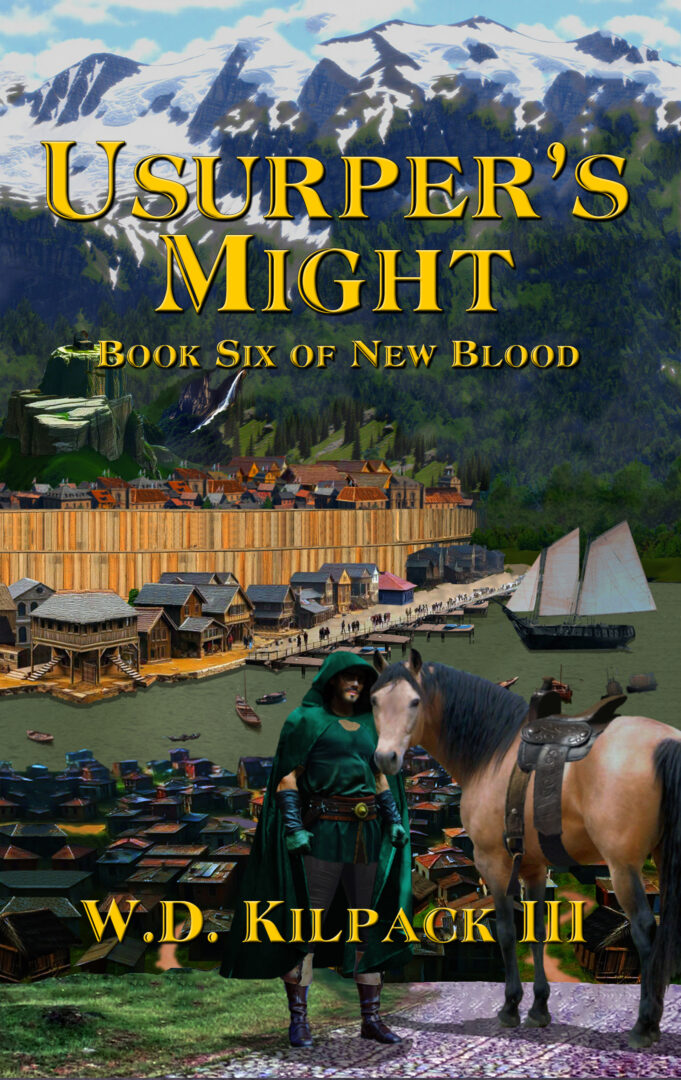
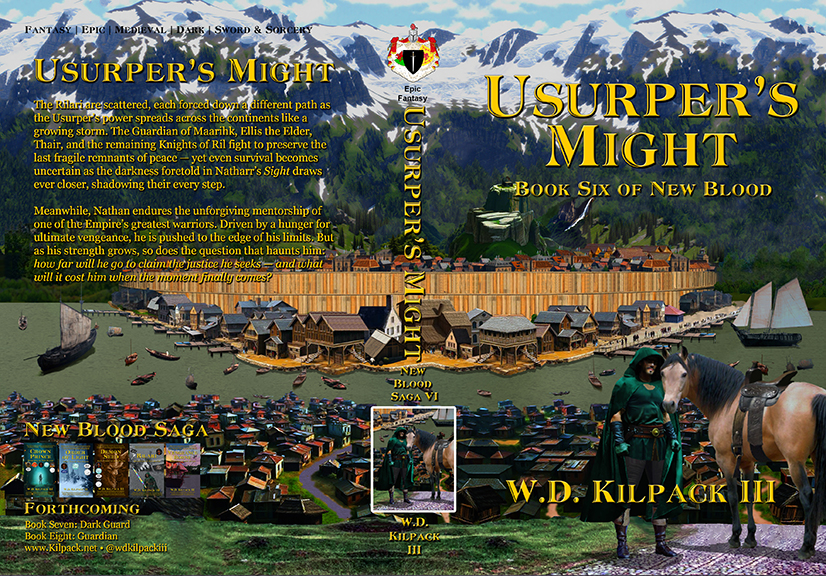
Usurper’s Might is where the storm that has been gathering since Crown Prince starts raining down. Readers can expect the scope to widen dramatically — politically, militarily, and emotionally — as the Usurper’s true power begins to surface. Up to this point, much of the danger has been hinted at, whispered about, or seen only in fragments. In Usurper’s Might, those shadows take shape, and the consequences become impossible to ignore.
For Natharr, this book forces him into decisions that test the very core of what it means to be the Guardian of Maarihk. He’s always carried the burden of Sight, but now the visions become sharper, more urgent, and far more costly. The choices he faces are no longer about what he can endure — they’re about what he’s willing to sacrifice when the fate of Mankind hangs in the balance.
Nathan’s arc also intensifies. He’s no longer the impulsive boy who believes himself invincible; he’s a young man confronting the weight of destiny without the benefit of Natharr’s early guidance. In Usurper’s Might, he’s pushed harder than ever — physically, emotionally, and morally. His training, his identity, and even his sense of belonging are challenged in ways that force him to grow or break.
What raises the stakes across the board is that the characters’ personal struggles and the grand sweep of prophecy finally collide. The internal conflicts they’ve been wrestling with — duty, identity, vengeance, loyalty — now have direct consequences for nations, armies, and the future of the world. Every choice matters. Every mistake costs.
Readers can expect revelations, turning points, and moments that reshape the trajectory of the Saga. Usurper’s Might is the point where the story starts to boil, and where the characters must decide who they truly are when the world demands everything of them. In the words of Robert Frost, “Never allow yourself to be made a victim. Accept no one’s definition of your life; define yourself.”
The story centers on a world where the Rilari are scattered and darkness is rapidly rising. What inspired the world-building behind this series, and how has it evolved as the story has progressed?
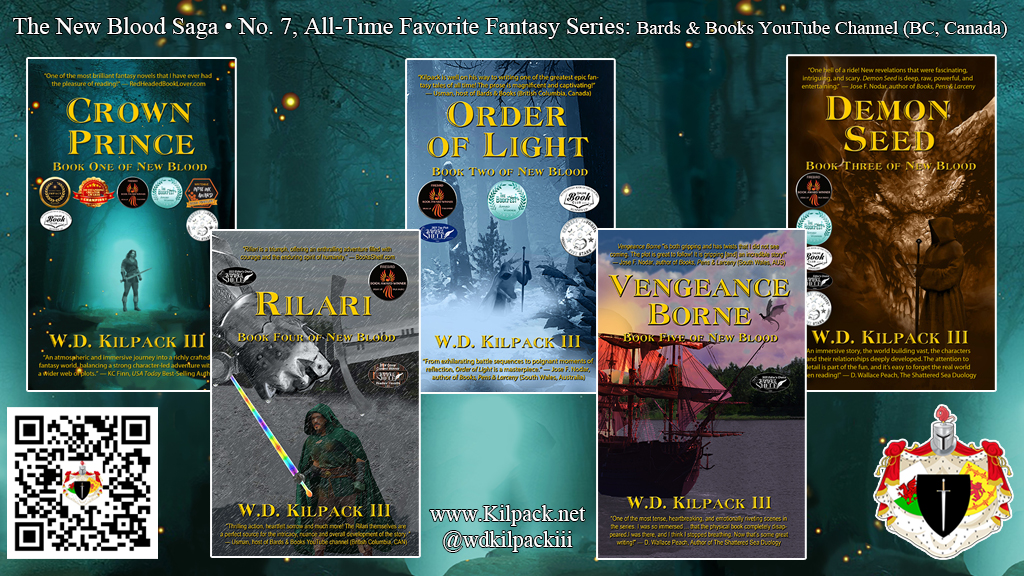
In the most recent Outstanding Creator Awards, my book Crown Prince: Book One of New Blood won Best World-Building (among other awards, it did well, I’m very grateful). As a result, I’ve had some people asking me for tips about world-building. With that in mind, I decided to put together some of those thoughts all in one place.
I’ve heard people say that world-building is daunting (translation: intimidating). I’ve heard people say it’s too hard. I’ve even heard some say it’s the reason why they don’t write fantasy or why they write urban fantasy.
Personally, I love world-building. For me, it embodies everything that writing is about: creation. When world-building, the author literally gets to play god. What’s more fun than that?
So here are some broad strokes of how I went about building the world of Vaaldiss.
1) Map
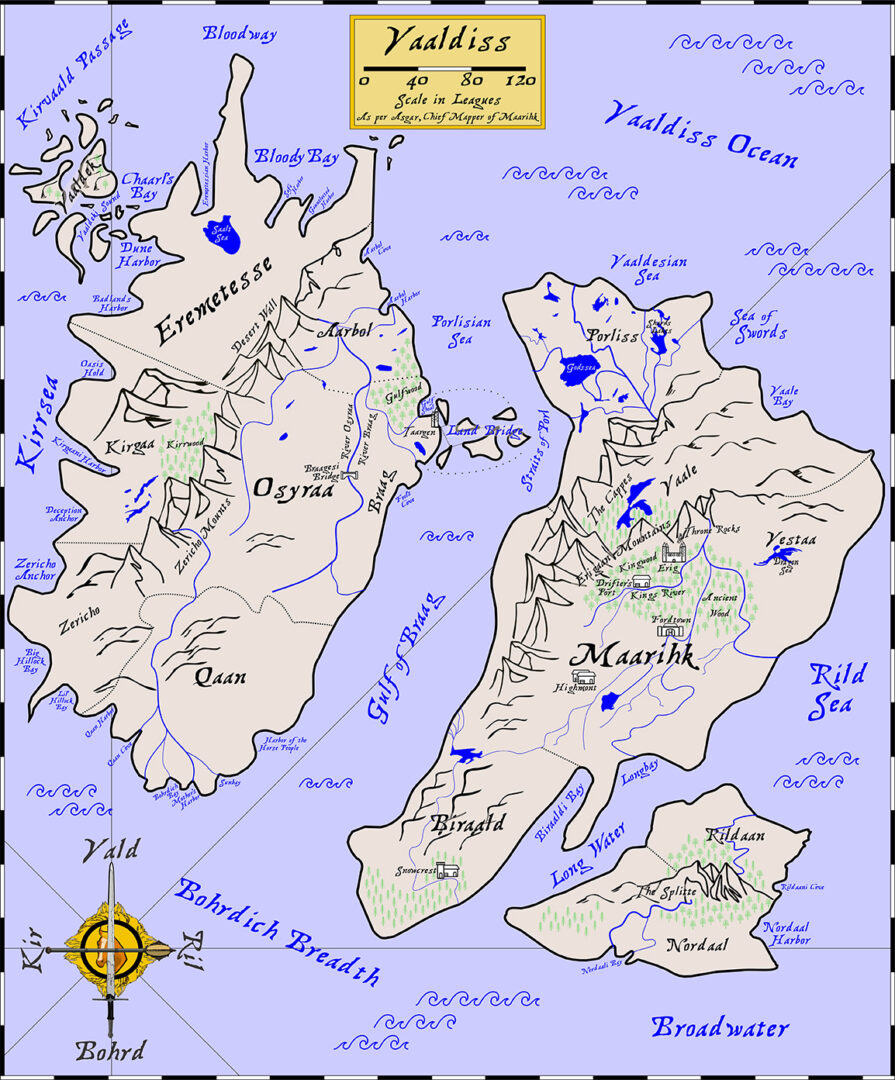
Where I usually start is with a map. I love maps. I have collected them since I was a kid. I sometimes get bored and draw them on my computer. So I literally have unused maps sitting around waiting for me to use them. For my New Blood Saga (for which Crown Prince is book one), I started with three things: a recurring dream I was having, a character I came up with while in college (who became Natharr), and a map. In this case, when I drew the map, I intentionally drew it so that the two main land masses looked like puzzle pieces that would fit together (just like Earth!). So what would cause the two land masses to exist? Two factions of gods having a war that they end up tearing the world in half, splitting it down the middle, taking control of their respective halves. So there are at least two different religions and at least two very distinct cultures.
2) Religions
Who lives in the lands on my map? There are two factions of gods. So one came first … the Olde Gods. That makes the other gods the New Gods. Which set of gods do I like more as a person? Or is there one? In this case, I decided that I would model the Olde Gods along lines that I like. So the New Gods are the snotty upstarts. If that’s the case, then how do they still even exist? There are enough of them that they … overpower the Olde Gods? No, too Greek. There are enough of them that they come to a stalemate. They split the world in half and … they no longer physically walk on the world. They give up physical presence on the world. So it follows that the people worshipping these gods follow suit, right?
3) Populations
What race would the Olde Gods create? The world, nature, flora, fauna … and the first people. What’s a cool name for that? The Olde Gods create the Firstborn. The other race is created by the New Gods (the snotty upstarts). What do you say to misbehaving children? “Ah-Ah, don’t touch that!” I thought, “Why not?” So the new race created by the New Gods are called the Aa. The Olde Gods created the animals … why? I decided at some point that there are only four Olde Gods (four gods, four compass points: Vald, Bohrd, Kir, and Ril), so they created them to be their army against some evil force. So they’re not just “animals.” That doesn’t sound like an army. They need a cooler name … like Great Beasts. And what are the Firstborn? The last of the Great Beasts ever created. They are bigger than the Aa. They live longer. They don’t reproduce as much. They are broader in the shoulders and narrower in the hips (like comic-book superheroes). They can also see into the future … sometimes … and not all of them. Has to be limited or the Aa wouldn’t have stood a chance. The Aa reproduce like rabbits. They overcome the Firstborn with mass numbers. They can’t even perceive of the mysteries of creation because it’s all about the here and now … they lack imagination. After they win the war, they force the surviving Firstborn into a corner of the world, one island, very small compared to the rest of the world. They then change the names of things, inserting double Aa into most of the names. But the Aa and the Firstborn can interbreed … and they do … and Firstborn culture seeps into Aa culture … at least on that half of the world. And what’s that great evil the Olde Gods have to fight? Not other gods … that’s already being done … Demons. Yeah … Demons of Chaos.
4) Cultures
There are different nations on these two lands. What kinds of cultures do I want? In the lands surrounding Maarihk (where the Firstborn were created), I want it to be more European-ish, maybe with some Celtic flair, because the ancient wood is so central to creation of the Firstborn and all the Great Beasts. A little bit of ancient Greece for flavor would be OK, particularly with the Great Beasts. There is an area pretty much cut off by mountains … mountain savages? That could be interesting ….
What about the other land mass (on the left)? On the map, the biggest piece of it is flat … savannahs? So maybe they’re nomadic? What nomadic cultures do I like? I’ve studied Native American culture since elementary school. That’s a no-brainer. But I don’t want to just make them an Indian tribe. What other nomadic culture could be mixed in to make it original? The nomadic culture is powerful … so the Mongols? Yeah … that would be cool. I always wanted to learn more about the Mongols, so this is my chance!
Then there is the country between the nomadic countries and the other land … it’s a blend of cultures (the two worlds).
Clearly, a lot more went into it than this. But this is literally how it went (in broad strokes). I took things I had in hand and played with them, spinning them into things that I thought would be fun to research, enjoyable to read, and made sense with the map and with the history that was inspired by its imagery. When these things were in place, I started writing Crown Prince.
Characters like Natharr and Nathan are facing intense personal and external conflicts. How do you approach developing characters who are navigating both destiny and deeply personal choices?
My approach to characters like Natharr and Nathan really began long before I wrote the first book, back when I was an undergrad studying philosophy. I was fascinated by Socrates. He would fall into a trancelike state and emerge with profound insight. He called it being seized by the Daemon of Philosophy. Even then I knew that one day I would create a character who embodied some facet of that mystery, that intensity of purpose. That character became Natharr.
Natharr’s trances — when he is seized by the Daemon of Sight and returns with visions of the future or the past — are my way of exploring that same intersection of reason, intuition, and destiny. Like Socrates, Natharr is also a soldier of great renown and someone who makes the hardest decisions because his principles and his duty demand it. Socrates chose hemlock rather than betray what he taught; Natharr carries that same willingness to shoulder the unbearable if it means fulfilling his role as Guardian of Maarihk. Natharr makes the choices no one else can or will.
Nathan (whose True Name is Vikari) grew from a different foundation. I wanted him to be extraordinary from the moment he could walk: athletic, brilliant, and bursting with energy. In a medieval world, that meant the sword would be his natural expression of talent. I’ve seen this kind of precocious talent firsthand with my own son in wrestling: if you don’t teach a gifted child the advanced techniques, they’ll see someone else do it and try it blind or invent them anyway. Nathan has that same unstoppable drive. As a teen, he’s the medieval version of an adrenaline junkie: impulsive, confident, and convinced of his own invincibility. That combination is powerful, but it’s also dangerous.
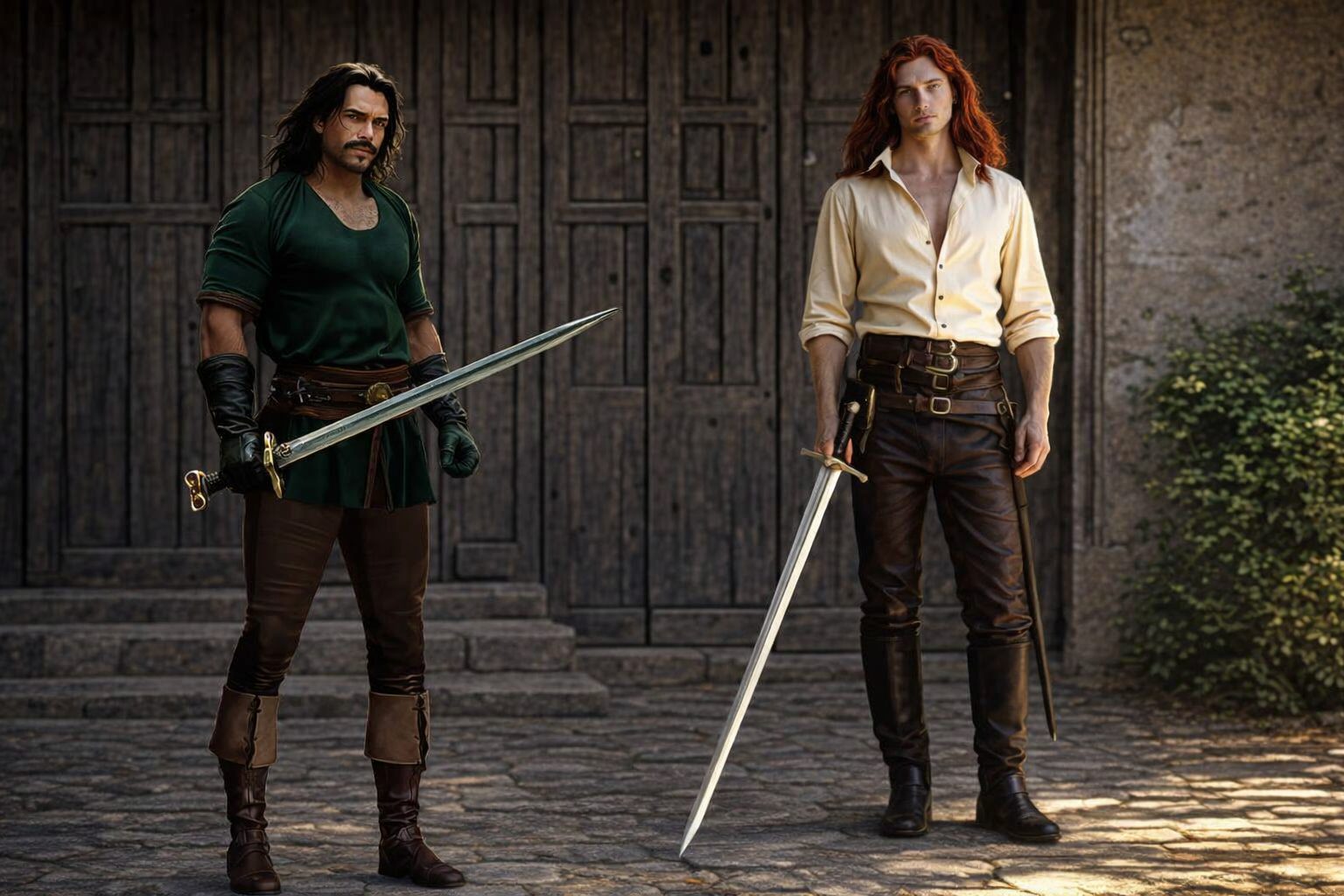
Both characters began with those seeds: Natharr, the best prepared Guardian in history, raised by a father who was the Guardian of Maarihk before him, and Saw what he would become; and Nathan, the crown prince shaped by prophecy but raised for half his life outside the world he’s meant to rule. Natharr has already walked the roads of prejudice, resentment, and jealousy that come with being Firstborn. Nathan must face those same forces without the benefit of Natharr’s early training or emotional grounding. Nathan’s conflicts are often internal — identity, belonging, the extremely heavy weight of expectation — while Natharr’s are written large across the fate of Mankind.
When I develop characters navigating both destiny and deeply personal choices, I start with this tension: what does fate demand of them, and what does it cost them to meet that demand?
For Natharr, the cost is often sacrifice. For Nathan, it’s often self-discovery. But for both, the heart of the journey is the same: how they reconcile who they are with who the world insists they must become. That’s where the story lives for me: in the friction between prophecy and personality, between what is written and what is chosen.
Nathan’s journey, in particular, explores themes of vengeance, mentorship, and moral limits. What drew you to that arc, and what questions do you hope readers reflect on through his story?
Very few of my characters are black-and-white. My characters are shades of gray. Those are the kinds of characters I love to read, as well. For example, villains who are just evil, because they were born that way, no explanation, etc., are one-dimensional and typically don’t hold my interest. Explanation and history explaining how it happens can be fascinating. Nathan as a character is shaped by profound losses but refuses to be defined by them. At the same time, those losses harden him, stripping away at the innocence of being raised in the depths of the ancient wood. Different mentors hone those experiences and further temper their influences on him. Nathan’s first mentor is Natharr, the Guardian of Maarihk, who tried to teach him how to be a good and just king one day. Yet, when Nathan is 7, Natharr has to leave, to return to the world to do his duty as Guardian. (He was never supposed to stay in the first place.) His next mentor is a secret friend, Quiet One, who becomes an unwitting father figure while teaching Nathan about the mysteries of imbuing artifacts with the essence of life, with the goal of summoning a companion for him that will be a protector who will 1) never leave him and 2) be capable of protecting him in ways Natharr never could. Those were the surface goals. There were hidden goals, also, like Quiet One taking some vengeance of his own in the process. His next mentor is his summoned companion, who teaches him about dealing with the challenges of new physical gifts. His next mentor is another father figure, a garrison captain, who recognizes his world-class gifts with a sword. He calls in the next mentor, who is not a father figure at all, despite Nathan’s wishes. He is unpleasant but could train Nathan to be one of the greatest swordsmen and put him in the company of the greatest warriors. He then escorts Nathan to his final mentor, who could help Nathan find his ultimate vengeance, despite being someone Nathan can barely stomach being around. This journey shifts from simple survival to pursuing justice, then morphs into something beyond, which is far more dangerous. The tensions between what Nathan wants, other temptations, and what he is becoming are fascinating. Every step forward has a price. Is the price worth it to make you stronger if that strength erodes the parts of you that are supposed to be protected? Is vengeance ever worthwhile or does it always demand that the person seeking it sacrifice too great a part of himself to achieve it? Nathan’s story is not about easy answers. It’s about the struggle to hold onto humanity when the world and even his own choices keep trying to take it from him. As far as questions … I hope readers ask themselves
- How far is too far?
- What do we seek (intentionally or not) when we chase retribution?
- Does mentorship save someone from their worst impulses or does it sometimes enhance them?
- What does it mean to choose a path that leads away from who you once were?
As this is the sixth installment in the New Blood series, how do you balance continuing a long-running narrative while still keeping each book fresh and engaging for readers?
I’ve been asked this question several times, and the real answer is never what people expect: I wrote all eight books straight through.
The New Blood Saga began because I was having a recurring dream. It was so vivid and emotionally charged that I would wake up in tears. It went on for months before I finally realized I needed to write it. The problem was that the dream gave me almost nothing about the characters. I was in the dream myself (which wasn’t helpful) so I had to look elsewhere for characters.
That’s when my background in philosophy became critical. As an undergrad, I was fascinated by Socrates — especially the moments when he would fall into a trancelike state and emerge with profound insight, something he described as being seized by the Daemon of Philosophy. I decided back then that, one day, I would create a character who was inspired by Socrates. Natharr grew directly out of that idea: a man seized by the Daemon of Sight, emerging from trances with visions of the future, a soldier of renown, and someone who — like Socrates — makes the hardest decisions because his principles and duty demand it.
That gave me a character and an endpoint, but I still needed a world. Around that time, I had been experimenting with drawing maps on my computer. I love maps — I collect them, and I’ve drawn hundreds. The one I was experimenting with on my computer felt right. That map became the setting, and with those three pieces — the dream, the character, the world — I had enough to begin.
At first, I thought I could capture everything in one novel. Very quickly, I realized that was impossible. The emotional weight of the dream, the relationships, the deeply penetrating gravitas — there was no way to do justice to all of it in a single book. So I expanded to a trilogy. Every night, I read that day’s writing to my wife — her “bedtime stories” — and she would stop me to point out where she thought a character (especially a woman) wouldn’t react the way I’d written. I revised constantly, layering in realism, psychology (my wife has a degree in psych), and depth.
But even three books weren’t enough. The world kept growing: mythology, pantheons, histories — they all required their space. The result? Starting book three, I hadn’t even gotten to the dream yet! So I gave myself permission to write six books.
Then, somewhere in book six, my wife asked, “Why does it feel like you’re rushing?”
I answered, “Because this is book six.”
She said, “So?”
I said, “It has to end in book six.”
She asked, “Why?”
I answered, “Because I only gave myself permission for this to be six books.”
She looked at me and asked, “What if I gave you permission for it to be longer than six books?”
“You can do that?”
“Can’t I?”
That was all it took. I expanded the series to eight books, which felt right — especially since the dream that started it all takes place in book four. And that’s where it stands … although the books keep getting longer. Rilari was so long that I moved four chapters into Vengeance Borne, and then four chapters from Vengeance Borne into Usurper’s Might. I’ve started to wonder if I’ll have to pull a Tad Williams (Remember? His Memory, Sorrow and Thorn trilogy? Then book three, To Green Angel Tower became two volumes, part 1 and part 2?) and split book eight into two volumes, but we’ll see. The story isn’t finished yet.
All of that is the long way of saying this: the reason each book stays fresh is because I never wrote them as separate installments. I wrote one enormous, continuous story.
Each book is a different panel of the same tapestry with new challenges, new revelations, and new emotional beats. But all part of a single, uninterrupted flow. I wasn’t trying to “keep things fresh”; I was simply following the characters where they led me. The consistency comes from the long arc. The freshness comes from the fact that the world, the characters, and the stakes keep evolving. And there’s still a whole lot of love and a whole lot of story left to pour into the New Blood Saga. Readers who join now still have time to fall in love with characters, to get angry at others (my wife certainly does, there are some characters that just saying the name makes her angry), anSd to feel the same emotional punch that started this entire journey for me.
Links:
- Usurper’s Might Book Page: https://kilpack.net/
usurpersmight.html - Official Website: http://www.kilpack.net
- Amazon Author Page: https://www.amazon.com/author/
wdkilpack - Goodreads: https://www.goodreads.com/
author/show/19339956.W__ Kilpack_III - BookBub: https://www.bookbub.com/
profile/w-d-kilpack-iii - Instagram: https://www.instagram.com/
wdkilpack/ - Twitter: https://twitter.com/WDKilpack
- Pinterest: https://www.pinterest.com/
WDKilpackIII/ - Threads: https://www.threads.net/@
wdkilpack - Discord: https://discordapp.com/users/
wdkilpackiii/ - Reddit: https://www.reddit.com/user/
WDKilpackIII